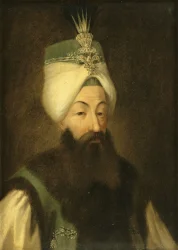
Selim I
Selim I ruled the Ottoman Empire for only eight years, yet his campaigns reshaped the political map of the Middle East. A forceful ruler who inherited a throne amid dynastic conflict, he turned the empire eastward against the Safavids and southward against the Mamluk sultanate. By the time he died in 1520, Ottoman authority extended across Syria and Egypt and reached the holy cities of Mecca and Medina, laying the groundwork for an empire that would dominate the region for centuries.
A Prince on the Frontier
Born in 1470, Selim was a son of Sultan Bayezid II. He spent years as governor of Trabzon, an important post on the empire’s northeastern frontier, where he gained experience of the politics and military pressures shaping the Black Sea and Caucasus regions. The Safavid state under Shah Ismail I was expanding nearby, and its growing influence among Anatolian communities alarmed the Ottoman court.
The succession was not peaceful. In 1512, Selim pressed his father to abdicate and took the throne. Rivalry among the princes had become a threat to the empire’s stability, and Selim moved decisively to secure his rule. The harsh measures taken against members of the ruling family helped earn him the epithet “Yavuz,” often rendered as “the Grim” or “the Resolute.” His accession signaled a more aggressive phase of Ottoman policy in the east.
Chaldiran and the Mamluk Campaign
In August 1514, Selim’s army met Shah Ismail’s Safavid forces at Chaldiran in eastern Anatolia. Ottoman artillery and firearms played a major role in the victory. The battle checked Safavid expansion and strengthened the Ottomans’ position in eastern Anatolia, although Selim did not conquer the Safavid state itself. The rivalry between the two empires continued long after his death.
Selim then turned against the Mamluk sultanate, which ruled Egypt, Syria, and the Hejaz. The contest was not simply a matter of territorial ambition: it involved control of strategic routes, the balance of power in the region, and the Ottoman-Safavid rivalry. In 1516, Ottoman forces defeated the Mamluks at Marj Dabiq near Aleppo; the Mamluk sultan Qansuh al-Ghawri died in the battle. The following year, Selim’s army defeated the Mamluk forces at Ridaniya and entered Cairo. With the sultanate broken, Syria and Egypt were incorporated into Ottoman rule, and the Hejaz came under Ottoman protection.
An Empire Transformed
These conquests greatly expanded the empire and brought it new cities, trade routes, resources, and responsibilities. Ottoman rule now included major centers of Islamic scholarship and commerce, while control over the pilgrimage routes to Mecca and Medina added immense religious significance to the sultan’s position. The victories also shifted the empire’s center of gravity: the Ottomans were no longer only a Balkan and Anatolian power, but a leading force across the Arab lands.
Selim died in 1520, leaving the throne to his son Süleyman, later known as Süleyman the Magnificent. His reign was brief, but its consequences were lasting. Through military success and uncompromising dynastic rule, Selim transformed an already formidable state into a major imperial power across three continents.