Sesar Valieho
 Peru
- Family and Education
- First Poems and Literary Life in Lima
- Imprisonment and Departure from Peru
- Poetry, Politics, and Exile
- Spain and the Final Poems
- Legacy
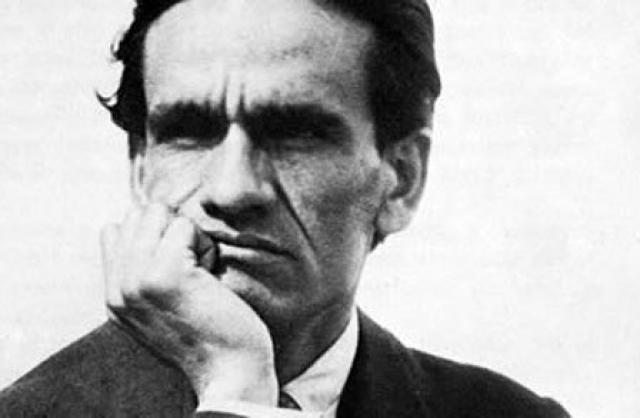
César Vallejo made poetry out of pain that was at once intimate and shared: the ache of exile, the memory of home, and outrage at a world that treated human suffering as ordinary. Born in a remote Andean town, he became one of the most daring voices in Spanish-language modernism, remaking poetic language while insisting that art stay close to real life.
Family and Education
César Abraham Vallejo Mendoza was born on March 16, 1892, in Santiago de Chuco, in northern Peru. He was the youngest of eleven children in a devout family. His grandmothers were Indigenous Chimu, and his grandfathers were Spanish Catholic priests; the blend of Indigenous and European heritage would remain part of the cultural landscape from which his writing emerged.
Vallejo began university studies in Trujillo in 1910, but financial hardship interrupted his education. He worked as a tutor and spent time in the accounts department of a sugar estate. There he saw the punishing lives of agricultural laborers, an experience that sharpened his awareness of social injustice. He returned to university in 1913, studied literature and law, and earned a master’s degree in Spanish literature in 1915.
First Poems and Literary Life in Lima
After teaching in Trujillo, Vallejo moved to Lima in 1917. The capital brought him into contact with writers and intellectuals, including the leftist thinker Manuel González Prada. His first major poetry collection, Los heraldos negros (The Black Heralds), appeared in 1918. The poems combined personal grief and religious unease with a distinctively Peruvian sensibility, announcing a writer who was already testing the limits of conventional poetic expression.
Vallejo’s next collection, Trilce, published in 1922, pushed much further. Its compressed language, unusual word choices, broken syntax, and abrupt rhythms made it difficult for early readers, but those very disruptions became central to its originality. Rather than smoothing experience into familiar verse, the poems seemed to fracture language under the pressure of grief, confinement, and uncertainty. Trilce is now regarded as a landmark of avant-garde poetry in Spanish.
Imprisonment and Departure from Peru
In 1920, after returning to Santiago de Chuco, Vallejo became entangled in a local political conflict. Authorities accused him of instigating violence and arrested him. He spent roughly three months in prison, an experience that deepened his sense of arbitrary injustice and isolation. He later drew on that period in his writing.
The unresolved legal case shadowed his prospects in Peru. In 1923 he left for Europe, arriving in Paris with little money and no settled career. He would spend most of the rest of his life abroad, moving between Paris and Spain and making several trips to the Soviet Union. His European years were marked by poverty and bouts of illness, but also by restless creative and political activity.
Poetry, Politics, and Exile
In Paris, Vallejo worked as a journalist and wrote about literature, politics, and society. He criticized what he saw as superficial imitation in contemporary poetry, arguing for work that could speak with authenticity. His own writing continued to evolve, drawing on Indigenous, Peruvian, and European traditions while resisting neat labels. Though sometimes described as a surrealist, his poetry cannot be contained by a single movement.
His political engagement also grew. Vallejo became a Marxist and wrote political reportage after traveling to the Soviet Union, including Rusia en 1931. His novel El tungsteno (Tungsten, 1931) turned to exploitation in Peru, depicting the harsh consequences of foreign corporate control over Indigenous workers. He also wrote stories, plays, essays, and journalism, though much of his work struggled to find publishers.
Vallejo’s relationship with Georgette Philippart became a central part of his later life. They married in 1934, after years together in Paris and Spain. When political conditions forced him to leave France for a period, he lived in Madrid before returning to Paris in 1932.
Spain and the Final Poems
The Spanish Civil War deeply affected Vallejo. He supported the Spanish Republic and produced some of his most urgent poems in response to the conflict. In the final years of his life, his work turned toward human solidarity and the cost of violence, while preserving the formal daring that had marked Trilce.
Vallejo died in Paris on April 15, 1938, after chronic illness. He was forty-six. Two major collections, Poemas humanos (Human Poems) and España, aparta de mí este cáliz (Spain, Take This Cup from Me), appeared after his death in 1939.
Legacy
Vallejo’s influence rests on both his innovation and his compassion. He transformed the possibilities of Spanish verse, making strange syntax and fractured rhythms carry the weight of ordinary suffering. His work draws on the specific histories of Peru and the Andes while reaching toward a wider human experience of injustice, grief, and fellowship. Though he received little recognition during his lifetime, he is now considered one of the major poets of the twentieth century.