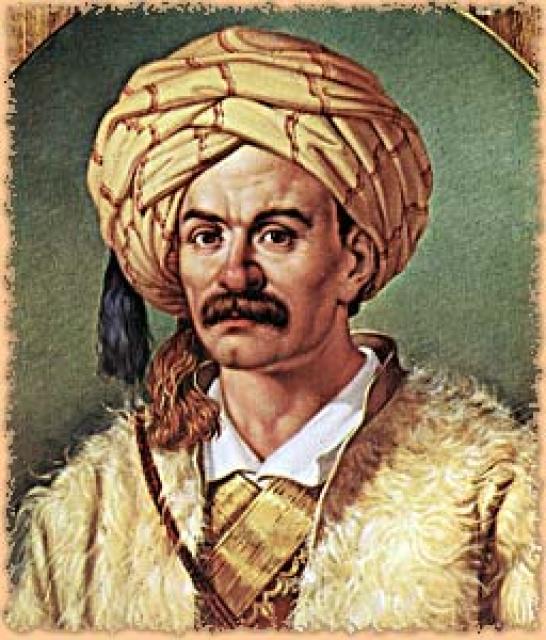
Sharle Favie
 France
- Early Life and Military Career
- Service in Dalmatia and the Mediterranean
- Involvement in the Spanish and Russian Campaigns
- Napoleonic Wars and the Restoration
- Philhellenism and the Greek War of Independence
- The Defense of the Acropolis and Political Intrigues
- Later Career and Legacy
Early Life and Military Career
Jean-Jacques-Antoine Cousin de Courchamps, Baron de Favré(1768-1852) was a French politician and philhellene. During the French Revolution, he was briefly imprisoned with his mother but was soon released. He studied at the École Polytechnique and served in the artillery, fighting in the Napoleonic Wars.
Service in Dalmatia and the Mediterranean
In 1807, Favré served in Dalmatia under Marshal Marmont, who made him his adjutant. He was dispatched to Constantinople to bolster its defenses against a potential British attack and later to Persia to fortify Isfahan against a potential war with Russia.
Involvement in the Spanish and Russian Campaigns
Favré fought in Spain in 1811 and participated in several battles. After the Battle of Salamanca, in which Marmont was severely wounded, Favré delivered a detailed report to Napoleon under fire. He took part in the Battle of Borodino, where he lost his right leg. Despite his injury, he returned to active service a few months later.
Napoleonic Wars and the Restoration
In 1814, Favré defended Paris under Marmont and signed the city's capitulation. He initially supported the restored Bourbon monarchy but was suspected of disloyalty during the "Hundred Days." In 1817, he was sent to Lyon to quell disturbances but was forced to resign due to his impartial investigations.
Philhellenism and the Greek War of Independence
In 1823, Favré joined the revolutionary government in Spain. When French troops intervened, he fought against them and later escaped to Greece. He led a unit of Greek and foreign volunteers against the Ottomans in the Morea. As a diplomat, he promoted philhellenism and lobbied for international support for Greece.
The Defense of the Acropolis and Political Intrigues
In 1826, Favré led a daring nighttime raid on the Turkish-held Acropolis of Athens, which he defended until June 1827. Despite his valor, his surrender and subsequent failed expedition to the island of Chios eroded his popularity among the Greeks. He became embroiled in political intrigues, advocating for the Duke of Nemours as a candidate for the Greek throne.
Later Career and Legacy
Favré returned to France and participated in the July Revolution of 1830. After the Revolution of 1848, he was appointed ambassador to Constantinople. He was elected to the Legislative Assembly in 1849, where he sat on the right. A statue was erected in his honor in Athens after his death. He published a memoir of his military experiences during the 1814 campaign in France.