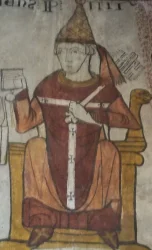
Siricius
Siricius led the church of Rome from 384 to 399, a period when the authority of Roman bishops was taking on a more formal shape. His name is especially associated with a letter answering questions from Himerius, bishop of Tarragona in Spain. That reply is the oldest completely preserved papal decretal, an authoritative letter that helped establish a lasting model for how the bishop of Rome could address church discipline across distant communities.
Early Church Service
Little is known about Siricius’s family or early life. An inscription associated with his burial indicates that he served the Roman church as a lector and then as a deacon during the pontificate of Liberius in the mid-fourth century. This long service gave him experience within the clergy of Rome before he became its bishop.
Siricius was elected after the death of Pope Damasus I in December 384. The Roman clergy chose him, and Emperor Valentinian II confirmed the election. The transition took place amid religious and political tensions in the late Roman Empire, where church leaders navigated doctrinal disagreements, imperial intervention, and disputes over ecclesiastical discipline.
A Letter with Lasting Influence
One of Siricius’s most important actions began with a letter that Himerius of Tarragona had sent to Damasus. It raised questions about baptism, penance, ordination, and the conduct of clergy. After Damasus died, Siricius responded in 385 with a detailed ruling known by its opening words, Directa ad decessorem.
The letter addressed a range of practical questions. It discussed when baptism should ordinarily be administered, how certain penitents should be reconciled, the requirements for ordination, and the continence expected of priests and deacons. Siricius instructed Himerius to share the response with other bishops in the region. Its form resembled an imperial rescript: a written answer from a central authority that set out rules for others to follow.
Earlier bishops of Rome had written letters to churches, and Siricius himself referred to earlier directives. What makes his response distinctive is that it is the earliest surviving papal decretal preserved in full. It shows the Roman bishop asserting a role in resolving questions of church order beyond the city of Rome. In later centuries, papal decretals became an important part of canon law, and Siricius’s letter is an early landmark in that development.
Discipline and Authority
Siricius’s surviving letters reflect his concern with clerical discipline and the responsibilities of church leaders. His directives were grounded in a view that the Roman church had a special responsibility in matters affecting the wider Christian community. Such claims developed over time, and Siricius should not be treated as the sole founder of papal primacy. His pontificate nevertheless provides clear evidence that the bishop of Rome was beginning to exercise authority through written rulings addressed to bishops in other regions.
The policy on clerical continence in the letter to Himerius has attracted particular attention. Siricius argued that clergy serving at the altar should observe sexual continence, extending a discipline already present in parts of the church. The rule was part of a broader concern to define the religious character and public conduct of the clergy.
Later Years and Legacy
Siricius remained bishop of Rome for about fifteen years and died on November 26, 399. He was buried in the cemetery of Priscilla in Rome. Later Christian tradition honored him as a saint, and his feast is observed in the Roman Catholic Church.
His historical importance rests less on personal biography, which is poorly documented, than on the surviving record of his decisions. Through the letter to Himerius, Siricius helped shape a form of church governance in which written responses could settle disciplinary questions across provincial boundaries. The decretal did not instantly create the later papacy, but it offers a rare and influential glimpse of Roman ecclesiastical authority taking a more formal, legal voice.