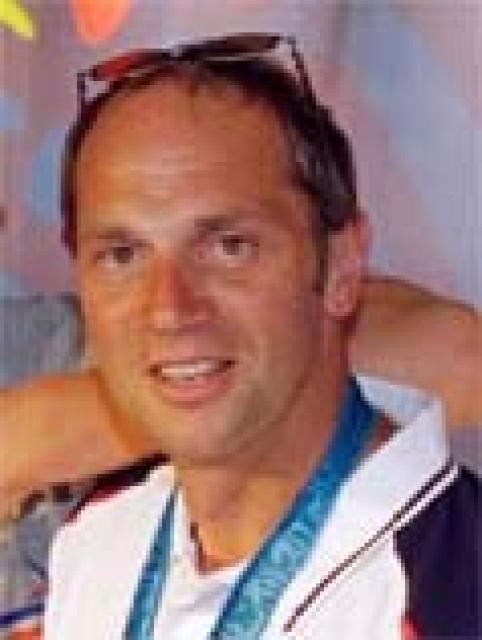
Stiven Redgrave
 Great Britain
Biography of Steve Redgrave
Steve Redgrave, the celebrated British rower and king of the sport, probably didn't think about his childhood while completing his victory lap on the smooth waters of the Sydney Olympic rowing course. Just after winning his fifth consecutive gold medal at the Olympics, he did something that no one had ever achieved in endurance sports. Even though his impromptu victory parade disrupted the tight schedule of the final races, none of the organizers dared to interrupt him. Redgrave was applauded by the admiring President of the IOC, Juan Antonio Samaranch, and Princess Anne, a well-known sports enthusiast. She even prepared to personally present the champion with his gold medal. And Redgrave, the embodiment of British pride, where rowing has always been held in high esteem, was simply ecstatic. Without a shred of guilt, like a child. After all, it was for these moments of happiness that he had pushed himself for the past four years.
Born on March 23, 1962, in Marlow, United Kingdom, Redgrave grew up in this suburban town located 30 miles west of London. It is home to one of the most famous rowing clubs in Britain. At first, the broad-shouldered son of a carpenter was interested in rugby, but one of his school teachers advised Steve to pick up an oar. As a teenager, he was drawn to winning, as he hated being in the back. The Thames, however, was a different story, and success came immediately. At the age of 16, Steve gave up on his futile attempts to continue his education and devoted himself to rowing. During this time, he had to work wherever he could: as a handyman, a courier for the local newspaper, but work never scared Steve - he was accustomed to hard work.
In the early 90s, already a two-time Olympic champion in the double sculls, Redgrave gained a reputation as a man who broke through psychological barriers instead of avoiding them. Left without a partner (who retired from the sport due to a serious injury), Steve decided to join forces with Matthew Pinsent. The pair was extraordinary: behind Pinsent were Eton and Oxford. But the hardworking Redgrave climbed the Olympic podium with him three times - first in the double sculls, then in the coxless four.
"When asked which of your medals is the most precious to you?" journalists in Atlanta probed, hinting at the latest one. Redgrave, smiling, replied, "Medals are like children. Can you really prefer one over another?"
Steve has two real children. Before their family life, there was a romantic relationship: Redgrave's wife was a sports doctor. This couple can easily be imagined on the doorstep of an English country house, surrounded by beech trees and outbuildings. The house does exist, but the leisurely, patriarchal way of life is more challenging - big sports and endless moves set different rhythms. Perhaps that's why Steve's wife breathed a sigh of relief after Sydney, saying, "It doesn't matter what he does now. The main thing is that he won't get back in the boat." She knows the true value of her husband's achievements. Steve is a reserved person, and his sports life has always been presented to journalists in its glamorous side. But there was also the other side of this life. In the autumn of 1997, after another triumph at the World Championships, Redgrave took a three-week vacation. The rest of a star of this magnitude is a relative concept: the lion's share of time is taken up by various official and semi-official events with their feasts and light drinking, leaving one thirsty. Once, after returning home, Steve drank four pints. But the thirst didn't go away. He called his wife, and as a doctor, she understood. A couple of days later, a final diagnosis was made - insulin-dependent diabetes. "That's when I remembered," Redgrave recalled, "how after Barcelona, the doctors noticed that I was "reacting incorrectly" to the tablets. They warned me then that it was a prelude to diabetes, but I ignored those words. Although I knew what diabetes was - my grandfather suffered from it. But, after all, I still have a long way to go until I'm 70, like my grandfather!"
Fate had a different plan - it sent Steve the disease when he was in the prime of his life. Redgrave never thought of giving up sports, but he had to forget about the excessive strain and switch to a more gentle regime.
A few months later, Redgrave discovered that strict dieting was rapidly draining his energy. Six hours of daily work on the water, in any weather, snow, cold, and rain, exhausting weightlifting exercises, overall physical fitness - all of this required his usual eating habits. The salvation came in the form of a new fast-acting insulin. Redgrave's menu once again included his favorite jam-filled donuts, which, as he noted with particular pleasure, had a noticeable effect on his athletic performance.
At first, his partners anxiously watched what was happening to Steve, but this truly indomitable man was able to convince them that diabetes was something like chronic nasal congestion, requiring constant medication. It seems that at first, he himself believed in it. But one day, while playing golf with Matthew Pinsent, Steve forgot to eat after taking his insulin injection and miraculously avoided a hypoglycemic coma.
Without losing a grain of his famous optimism, Redgrave became more cautious. Neither the fans nor his teammates had any idea of how serious Steve's illness was - how elegantly (without fear of this word) and courageously he coped with it.
After the fanfare of Sydney faded away, Redgrave held a press conference. "After so many assurances that my career was over, no one will believe me when I say that I am really done with sports. But no, friends, this time it's truly over. I'm exhausted - not even physically, but morally. I need to search for myself in something else, try to live an ordinary human life."
However, it is still impossible to imagine the idyllic life of the 42-year-old "river wolf" in the countryside, surrounded by English beech trees and solid outbuildings. The Athens Olympics is in front of his eyes. And Steve Redgrave is the coach of young English rowers who, under his guidance, are set to win "gold" after "gold". It's just the way it is with Redgrave.