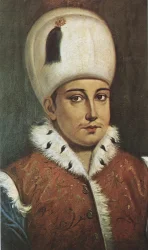
Suleiman II
Suleiman II ruled the Ottoman Empire from 1687 to 1691, taking the throne during a difficult war against the Habsburgs and their allies. He had spent decades confined in the palace as a royal prince and was nearly forty-six when he became sultan. His short reign saw major military setbacks followed by a revival under Grand Vizier Köprülüzade Fazıl Mustafa Pasha, whose reforms helped the empire recover some lost ground.
Years in the Palace
Suleiman was born in Istanbul on April 15, 1642, the son of Sultan Ibrahim and Saliha Dilaşub Sultan. He was a younger half-brother of Sultan Mehmed IV. After changes to Ottoman succession practices, princes who were not chosen to rule could be kept in the palace rather than sent to govern provinces. Suleiman spent about four decades in the section of Topkapı Palace known as the Kafes, or “cage.”
The long confinement limited his experience of government and public affairs. Accounts suggest that he devoted himself to religious study and lived a life very different from that of an active prince. In November 1687, military reverses and a Janissary revolt led to the deposition of Mehmed IV. Suleiman was brought from the palace and proclaimed sultan, becoming the twentieth ruler of the Ottoman dynasty.
A Throne in Crisis
The empire was then fighting the Great Turkish War, a conflict against the Holy League, which included the Habsburg monarchy, Poland-Lithuania, and Venice. The Ottoman defeat at the Second Battle of Mohács in 1687 was followed by Habsburg advances into Ottoman-held Hungary and the Balkans. The army was unsettled, the treasury strained, and authority in the capital contested.
Suleiman initially kept Siyavuş Pasha as grand vizier and tried to restore order. The political turmoil continued, however, with military unrest and competing factions weakening the government. In 1689, Suleiman appointed Fazıl Mustafa Pasha of the Köprülü family as grand vizier. The new minister reorganized finances and military administration, worked to restore discipline, and sought to reduce abuses that had eroded support for the state.
Military Recovery
Under Fazıl Mustafa Pasha, Ottoman forces recovered Niš and Belgrade in 1690, reversing some of the Habsburg gains. These successes restored confidence and helped stabilize the empire’s position in the Balkans. The sultan supported his grand vizier’s policies, though the surviving evidence makes it difficult to separate Suleiman’s personal direction from the work of his ministers.
In 1691, Ottoman forces again campaigned against the Habsburgs. At the Battle of Slankamen on August 19, the Ottoman army was defeated, and Fazıl Mustafa Pasha was killed. The battle halted the recent recovery and brought the costs of the war into sharp focus. Suleiman himself was seriously ill by this time and did not long survive his grand vizier.
Death and Legacy
Suleiman II died at Edirne on June 22, 1691, after a reign of less than four years. His brother Ahmed II succeeded him. Suleiman’s body was returned to Istanbul and buried near the tomb of his namesake, Suleiman the Magnificent, at the Süleymaniye Mosque complex.
His reign is remembered as a period of crisis and partial recovery. The long years of confinement meant that he entered power without the experience usually gained by an Ottoman prince, and the state depended heavily on capable grand viziers. Yet his appointment of Fazıl Mustafa Pasha helped restore administrative and military effectiveness at a time when the empire faced serious danger. Suleiman’s story reflects both the constraints of palace succession and the importance of ministerial leadership in Ottoman government.