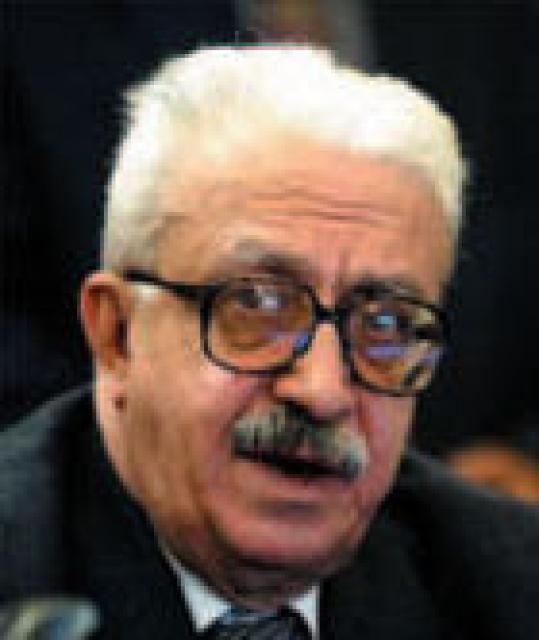
Tarik Aziz
 Iraq
Iraq- Early Life and Education
- Political Career
- Minister of Information and Deputy Prime Minister
- Minister of Foreign Affairs
- Post-Saddam Capture and Trial
- Legacy
Early Life and Education
Tarek Aziz was born on April 30, 1936, into a Chaldo-Christian family in the village of Tell Keppe, near Mosul, Iraq. His original name was Mikhail Yuhanna, but he later changed it to Tarek Aziz, meaning "glorious past." Aziz's father was a minor official in the local administration. As a young boy, he moved with his family to Baghdad, where he graduated from the capital's College of Fine Arts. In 1957, he completed his studies in English literature at Baghdad University, specializing in English literature.
Political Career
Aziz joined the Ba'ath Party while still in college and became a columnist for the newspaper "Al-Jamahir." He played a key role in the first Ba'athist coup in 1963, serving as editor of "Al-Jamahir." However, the military overthrew the Ba'ath later that year, and Aziz fled to Damascus, where he continued his journalistic career with the Syrian branch of the party.
In 1966, Aziz returned to Iraq and participated in the preparation for the second Ba'athist coup in 1968. Shortly after, he became editor-in-chief of the new party publication "At-Thawra." His ascent in the Iraqi leadership began in 1972. He headed the Press Association, which controlled the media, from 1969 to 1974.
Minister of Information and Deputy Prime Minister
In 1974, Aziz was appointed Minister of Information by Saddam Hussein. This marked his first appearance on the international stage. His command of English and knowledge of history and world politics made him a valuable asset to the regime. In 1977, Aziz resigned from his ministerial post, but upon Saddam's rise to the presidency in 1979, he was appointed Deputy Prime Minister.
Minister of Foreign Affairs
In 1980, Aziz was targeted in an assassination attempt by radical Islamic groups. He survived the attack and continued to serve as Deputy Prime Minister. In 1983, he was also appointed Minister of Foreign Affairs. He held this position until 1991, representing Iraq during the Gulf War.
In 2001, Aziz was briefly reappointed as Minister of Foreign Affairs, but he was replaced shortly after.
Post-Saddam Capture and Trial
Following the fall of Saddam Hussein's regime in 2003, Aziz was captured by American troops on April 24, 2003. He was put on trial alongside other members of the Iraqi leadership, including Saddam Hussein.
At his trial, Aziz denied any personal responsibility for any killings. He argued that the responsibility for any crimes committed lay with the leadership as a whole rather than individual members. He did not testify against Saddam Hussein and his co-defendants.
Despite not facing any specific charges, Aziz was not released from prison. He suffered from diabetes and other health issues and was hospitalized several times.
Legacy
Tarek Aziz died in prison on June 5, 2015. He was widely regarded as a skilled diplomat and a moderate voice within Saddam Hussein's regime. His legacy remains complex, as he was both a loyal servant to a brutal dictatorship and an advocate for peace and reconciliation.





