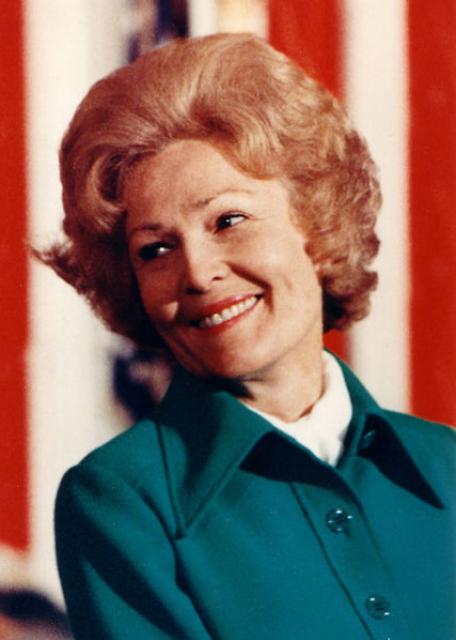
Telma Rian Nixon
 USA
USABiography of Thelma Ryan Nixon
Thelma Ryan Nixon, commonly known as Pat, was the wife of the 37th President of the United States and was often referred to as the "goodwill ambassador." She was the first First Lady to be sent abroad by her husband on an official diplomatic mission. In May 1970, she flew to Peru to assist earthquake victims. The Peruvian President, General Velasco Alvarado, awarded her with the Grand Cross of the Order of the Sun, the highest honor in the Western Hemisphere for a non-Peruvian citizen. Despite avoiding public appearances and never giving interviews, she was considered an active First Lady. From January 1969 to August 1974, she attended 986 official events.
Pat Nixon was also the first First Lady to be sent abroad with an official diplomatic mission. In May 1970, she flew to Peru to help earthquake victims. Peruvian President General Velasco Alvarado awarded her the Grand Cross of the Order of the Sun, the highest honor in the Western Hemisphere for an American woman. In 1972, she stood in for her husband at the swearing-in ceremony of the President of Liberia. She was often referred to as the "goodwill ambassador." Although she was entrusted with important diplomatic assignments, she played no political role in the White House. Among the First Ladies of our time, she was one of the least significant, never giving official speeches, writing articles, or giving direct answers to journalists' questions. Her biographer, David Lester, called her the "lonely lady from San Clemente" (the Nixons' home was located in San Clemente, California). Others called the wife of Nixon "Plastic Pat," "Antiseptic Pat," or "Pat-bot." People saw Pat's smile, but it seemed artificial. They said she resembled a plastic doll, always smiling the same smile, regardless of what was happening around her. Pat's daughter, Julie, dedicated several publications to her mother, including a comprehensive biography, in which she claimed that people underestimated her. Julie saw her mother in a completely different light and described her as energetic, witty, and gentle.
Pat Nixon was born on March 16, 1912, in the small town of Ely, in the mountains of Nevada. Her father, William Ryan, worked in a copper mine. He only found out about his daughter's birth when he returned after his night shift on March 17, St. Patrick's Day. Without much thought, William Ryan decided that since his daughter was born on March 17, her name would be Pat. And she celebrated her birthday on March 17 for the rest of her life and, of course, kept that name - Pat. Her mother, Kate Halberstadt Bender, was originally from Hesse, near Frankfurt-on-the-Main. When Pat was two years old, her father left his job at the mine due to his health. In search of a new place, he moved with his family to California and bought a small farm in Artesia, 30 kilometers southeast of Los Angeles. From an early age, Pat grew vegetables with her two older brothers.
In 1925, when Pat was 13 years old, her mother passed away. From then on, she not only attended school but also took on all the responsibilities of a housewife: cooking, cleaning, and helping in the fields. Two years later, she started taking care of her severely ill father. It was an unbearable burden for a young girl. "Life was sad, but I tried to give strength to others," she later recalled. Her favorite pastime was books: "Books had the greatest influence on my life. They expanded my horizons. That's how I learned that there is much more in the world than what surrounds us."
At the age of 17, she lost her father, which was a great sorrow for her. Even after many years, she admitted, "I don't like to remember that time." She dutifully managed the household, attended senior classes in school in Whittier, and participated in performances of the school's amateur theater troupe. In 1974, when Gloria Steinem asked her about her childhood, Pat sadly replied, "I had a difficult childhood. I am not like all of you; everything was easier for you." Despite such a difficult life, she completed high school and dreamed of traveling to experience life in other countries. This led her to decide to continue her education. She worked as a janitor and then served in the First National Bank in Artesia while attending lectures at Fullerton College, a part-time college.
In 1930, she decided to try her luck in New York, and to save money for the trip, she worked as a driver. With a large amount of luggage, together with an elderly couple, Pat set off for the largest city in the United States. Despite the severe economic crisis, Pat quickly found a job at a hospital, where she initially worked as a secretary for two years and then as an assistant to a radiologist, caring for lung patients. "There is nothing that gives a person as much satisfaction as helping others," she said. In New York, Pat actively participated in public life but lived very modestly, saving money for further education. After a few years, she had enough money to return to Los Angeles. She moved into her brothers' apartment and began studying at the University of Southern California in the fall of 1934. Pat was a good student and specialized in business, but she had to work constantly to support herself and her studies. She worked in a department store, then as a telephone operator, assisted a dentist, graded student papers, and even got a few extra roles as an extra in movies. Her biggest role in a film consisted of one line, for which she received $25 in Hollywood. Frank Baxter, with whom Pat attended a seminar on Shakespeare, later recalled that she always came to class tired. "I remember one time I went to the cafeteria and saw Pat. She was behind the counter serving food. An hour later, I met Pat in the library, where she was handing out books. When I returned to the university in the evening, she was checking student papers. But despite such a workload, she was a good student." In 1937, Pat graduated from the university and wanted to work in the retail industry, but she received an offer to work in a school in Whittier, California, for $190 a month. At that time, it was an extremely attractive offer. The city was founded in 1887 as a Quaker settlement. When Pat arrived there, it had a population of 25,000, and not only Quakers lived there.
In the middle school, she taught geography and typing. She quickly became involved in the cultural and social life. A young lawyer named Richard Nixon heard about the new "charming" teacher who was supposed to play a role in Alexandra Woollcott and George Kaufman's play "The Dark Tower." To see the young lady, he attended a rehearsal of the amateur theater and even got a role there. It was a romantic role, and his partner was Pat. Later, he recalled their meeting: "I thought I knew everyone in town, and suddenly before my eyes appeared a beautiful, energetic woman with copper-colored hair whom I had never seen before. I couldn't take my eyes off her." She captivated him. For him, it was "love at first sight." It's no wonder that on the same evening, he said to her, "I would like to date you." - "I'm too busy," she replied. - "Don't say that, I'm going to marry you anyway."
Pat was not thrilled with this conversation. "I couldn't even imagine that someone could talk like that so suddenly," she recalled many years later. At home, she told her friend, "Today I met a guy who wants to marry me." Eventually, he proposed to her. In a large bouquet of flowers, he gave her an engagement ring.
On June 21, 1941, they had their wedding ceremony, according to the Quaker tradition. Pat was 28 years old, and Richard was 27. Pat recalled that "it was a beautiful wedding." They went on their honeymoon to Mexico by car. During the 1968 election, Nixon nostalgically recalled that trip: "Sometimes we drove all night to save money on hotels. It seemed that for $178, we saw all the temples and churches in Mexico."
Nixon was a lawyer, and in California, he had enough income, but he did not intend to stay there forever. Pat continued to work at the school.
In 1941, they moved to Washington, where Nixon obtained a position in the Office of Price Administration. In Ottumwa, Iowa, Nixon studied and received the rank of Lieutenant Commander in the Navy. Pat worked at a bank. When he was sent to the South Pacific, an area of active military operations, she moved to San Francisco and worked there until his return from the front in 1944. During this period, they exchanged letters every day.
On February 21, 1946, Pat gave birth to their first daughter in California. They named her Patricia, but her parents called her Tricia. Their second daughter, Julie, was born on July 5, 1948, in Washington. In 1968, Julie married David Eisenhower, the grandson of President Eisenhower.
Nixon's political career began after the war. Pat was not interested in politics, but she had no objection to her husband pursuing a political career, with two conditions. Firstly, politics should not intrude into their personal lives so she could focus on raising their children. Secondly, her husband would not ask her to give political speeches. Nixon, of course, accepted these conditions. Needless to say, both conditions were impossible to fulfill.
In 1946, in the 12th Congressional District of California, Nixon ran for a seat in Congress. Pat worked in his campaign office, typed texts on a typewriter, answered letters, distributed leaflets, but it was clear that she did not enjoy this activity. Her smile at pre-election events seemed forced, and her behavior was too nervous. In direct interactions, she was always tense. She still had much to learn.
Although Nixon conducted an unusually dirty pre-election campaign and was criticized for it, Pat always supported her husband. To help Nixon fend off attacks from opponents, she transcribed their speeches. She also always tried to spare him unnecessary worries so he could focus on the most important issues.
In 1952, President Eisenhower offered Nixon the candidacy for Vice President. Pat doubted whether her husband should accept this offer. She didn't know if she could endure another election, this time nationwide, and she was afraid she might not be attentive enough to the children. But in the end, she agreed. In 1952, during the Republican Party convention in Chicago, she was having lunch with friends when she suddenly heard on the radio that her husband had been nominated as the candidate for Vice President by acclamation. She hurried to the meeting hall and managed to join her husband and the Eisenhowers on the podium.
They spent the 1952 pre-election campaign "in one harness," Pat recalls. She met with women, made speeches, distributed leaflets, and answered letters. This time, they visited Ely, Nevada, where Pat was born forty years ago. Despite the fact that the city's voters were mostly Democrats, they received a warm welcome.
During the pre-election campaign, it became known that Nixon secretly received financial support from California businessmen. He was asked to withdraw his candidacy. Nixon was already prepared to agree, but Pat objected. "You have no right to give up," she said. "If you give up now, Eisenhower will lose the election. He can get rid of you himself if he wants to. But if you don't go on the offensive, if you back down, you will be destroyed politically. And your whole life, the life of your family, and especially your daughters will become an unfulfilled dream."
He consulted with his advisers and decided to fight. On September 23, 1952, he appeared on television with an address broadcast nationwide. With a voice trembling with tears, he described the difficult financial conditions in which his family lived. His wife didn't even have a fur coat like "the wives of the Democratic sellouts; she wears an ordinary Republican coat made of cheap material. I keep saying how good it looks on her."
In this melodramatic address, he refuted the fact that he received expensive gifts, except that his daughter received a small dog as a gift.
Pat suffered greatly from this scandal. When the wife of Eisenhower told her that the financial scandal had harmed her husband, she objected, "You have no idea what we went through."
After the election, Nixon said that his wife "will do everything to support my political career, but she hates politics and dreams of the day when the political chapter in my life will end."
As the wife of the Vice President, Pat managed the household, went shopping, cooked, ironed, and raised their children. She always tried to stay in the background, avoiding the media and any statements that could put her husband and the Eisenhower administration in an awkward position. Nixon was proud of her: "Pat is so smart that she only says what is necessary and avoids controversial issues." If reporters asked more detailed questions, she would smile sweetly and remain silent.
Friends considered Pat straightforward, warm-hearted, and cheerful, with a sense of humor. She could even make the perpetually serious and somewhat pompous Nixon laugh, but she only did so in a small circle of friends. She never allowed anything like that in public. One evening, Pat entered the salon holding a tray with various treats and serving them to friends, she said, "Try it! It's delicious, and I made it myself."


