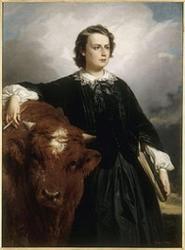
Thomas Sidney Cooper
 Great Britain
- Biography of Thomas Sydney Cooper
- Early Life and Education
- Artistic Influences in Belgium
- Return to England and Recognition
- Notable Works
Biography of Thomas Sydney Cooper
Thomas Sydney Cooper was an English painter who was born on September 26, 1803, in Canterbury, England. He was mostly known for his idyllic landscapes and depictions of animals, which were reminiscent of the works of Flemish masters.
Early Life and Education
Cooper discovered his passion for drawing and painting at a young age and was largely self-taught. He earned a living by selling paintings of his hometown, Canterbury, and its surroundings. By the age of seventeen, he secured a position as a decorator at a theater in Hastings.
Seeking further artistic education, Cooper moved to London and studied at the British Museum and the Royal Academy of Arts. After completing his studies, he returned to Canterbury and taught drawing for a period of time.
Artistic Influences in Belgium
In search of new opportunities, Cooper traveled to Belgium. Although he faced difficulties, he eventually arrived in Brussels. Here, he found appreciators of his talent and became acquainted with many prominent local artists, particularly Verboeckhoven. Under Verboeckhoven's influence, Cooper began painting idyllic landscapes and animals in the style of the old Flemish masters.
Return to England and Recognition
The Belgian Revolution of 1830 compelled Cooper to return to his homeland. From 1833 onwards, he consistently participated in art exhibitions in London. While his paintings appealed to the English audience, with their content, composition, and overall style reminiscent of A. Cooper's works, he received full recognition from the French, who regarded him as one of the premier painters in his chosen specialty.
In 1845, Cooper was honored by his election as a Corresponding Member of the Royal Academy of Arts, and in 1867, he became an Academician.
Notable Works
Some of Cooper's best-known works include "Evening at the Watering Hole" (1842), "Milking Cows in the Meadow" (1864), "During a Heavy Rain Shower" (1870), "Children of the Mist" (1872), "King of the Meadows" (watercolor, 1873), and "Maternal Tenderness" (1876). He also exhibited two paintings at the 1878 Paris World Exhibition: "Glen Coe Rocks, Scotland" and "Pasture in Kent".