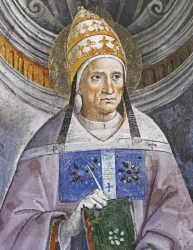
Valentine
Pope Valentine held the papacy for only a few weeks in 827, leaving one of the briefest and least documented pontificates in Church history. A Roman cleric who had served as a senior church official under two predecessors, he was chosen after the death of Pope Eugene II. His short reign ended before any record of major decisions or initiatives could emerge.
A Roman churchman
Valentine was born in Rome, probably in the city’s Via Lata district. His birth date is unknown. According to the medieval “Liber Pontificalis,” he entered the service of the Church while still young and earned a reputation for piety and good conduct.
Pope Paschal I made him an archdeacon, a senior role in the Roman church, and placed him in charge of the Roman diaconate. Valentine retained influence under Pope Eugene II, who reigned from 824 to 827. Those years were marked by close involvement of the Carolingian rulers in Roman affairs, including regulations governing the city and the relationship between the papacy and the empire.
A very short pontificate
Eugene II died on August 27, 827. The clergy, nobles and people of Rome chose Valentine as his successor. Medieval accounts describe the election as unanimous: the electors reportedly found him praying at the Basilica of Santa Maria Maggiore and led him to the Lateran before his consecration at St. Peter’s.
The length of his reign is reported differently by early sources. The “Liber Pontificalis” says Valentine occupied the papal see for about forty days, while the annals of Einhard suggest barely a month. He died around October 827, before his pontificate could leave a substantial documentary record. Modern lists generally place him among the popes of August and September 827.
A small but revealing chapter
Because Valentine’s time as pope was so brief, little is known about his policies or personal views. His election is nonetheless a glimpse into a period when the Roman clergy, local elites and people all played a role in choosing the bishop of Rome, while the Carolingian emperors remained powerful participants in Italian affairs.
Valentine’s legacy is defined less by individual acts than by the unusual brevity of his pontificate. He remains a historical footnote with an evocative outline: a Roman archdeacon praised for his character, elevated to the papacy, and gone only weeks later.