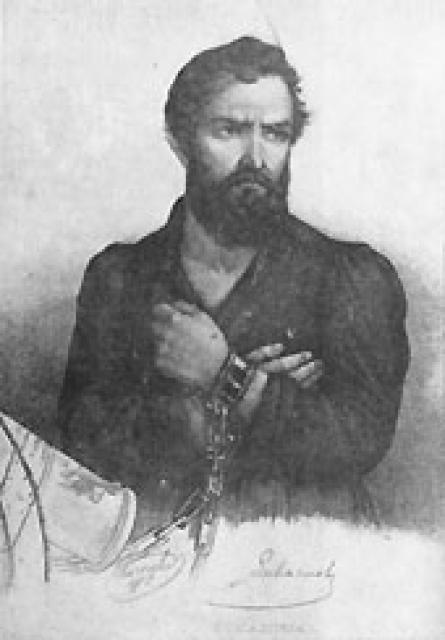
Valerian Lukasinskiy
 Poland
- Jan Łukasiński: Polish Officer, Conspirator, and Political Prisoner
- Return to Poland and Founding of National Freemasonry
- Arrest and Imprisonment
- Polish Uprising and Extermination
Jan Łukasiński: Polish Officer, Conspirator, and Political Prisoner
Military ServiceOn April 15, 1807, Jan Łukasiński joined the army of the Duchy of Warsaw. He served in the rifle regiment raised in Płock, participating in the summer campaign against the Prussians and Russians. Łukasiński distinguished himself in several battles and was promoted to second lieutenant.
Following the reorganization of the Duchy's troops, Łukasiński transferred to the Sixth Infantry Regiment and later became aide-de-camp to Prince Jabłonowski, inspector of the military ministry's administrative department. In 1809, as a lieutenant, he participated in the Austrian campaign and was promoted to captain of the first mixed Galician-French infantry regiment formed there. After peace was concluded, he was transferred to the military ministry, preventing him from participating in the Russian campaign of 1812.
However, in 1813, Łukasiński joined the Russian army and participated in the foreign campaign. During the capture of Dresden, he was taken prisoner by the Austrians, but was released on July 8, 1814, thanks to the intervention of Emperor Alexander I.
Return to Poland and Founding of National Freemasonry
Upon returning to Warsaw, Łukasiński entered the army of the Kingdom of Poland, reorganized by Grand Duke Constantine Pavlovich, as a captain in the Fourth Line Regiment. He rose to the rank of major by March 20, 1817.
In 1818, Łukasiński wrote a pamphlet entitled "Remarks of an Officer on the Acknowledged Need for Settling the Jews in Our Country," which responded to an anti-Jewish brochure by Prince W. Krasiński. In 1819, he founded "National Freemasonry" (Wolnomularstwo Narodowe), a Masonic organization with the official goal of improving morality in the army and society. However, its hidden purpose was to spread Polish national ideas and prepare for an uprising aimed at Polish independence. National Freemasonry had approximately 200 members, mostly officers.
In 1820, National Freemasonry was formally disbanded, but Łukasiński created a more deeply conspiratorial patriotic society in its place.
Arrest and Imprisonment
In the summer of 1822, Łukasiński and his comrades were arrested. A special commission investigated the "National Freemasonry" case, but the authorities remained unaware of the "Patriotic Society." Łukasiński protected his comrades but admitted to his own struggle for Polish independence. On June 1, 1824, a military court sentenced him to nine years in prison; Emperor Alexander I reduced the sentence to seven years.
In the Zamość fortress, where Łukasiński was incarcerated, he attempted to organize a garrison mutiny to escape. Grand Duke Constantine Pavlovich doubled his sentence as punishment. In October 1825, Łukasiński gave extensive testimony about the "Patriotic Society," but no one was arrested until after the Decembrist uprising, when his testimony was revisited. Łukasiński was transferred to Warsaw and imprisoned in the Volhynian Regiment barracks.
Polish Uprising and Extermination
When the Polish uprising erupted in 1830, the retreating Russian troops took Łukasiński with them. On the orders of Nicholas I, Łukasiński was incarcerated in the Schlisselburg Fortress in late December 1830, where he remained for the rest of his life.
After Nicholas I's death, Łukasiński was not included in the amnesty granted to Polish rebel leaders to mark the coronation of the new emperor. In 1858, Łukasiński's niece was denied a meeting with him. In 1861, the commandant of Schlisselburg petitioned the emperor to alleviate the conditions of the 75-year-old prisoner, who was suffering from poor sight and hearing, as well as being in poor health. Alexander II ordered that Łukasiński be moved to a brighter cell and allowed to walk within the fortress. In 1862, Łukasiński was granted access to a Catholic priest, but his request for a visit from his family was denied. Łukasiński died in February 1868, having spent 46 years in prison.