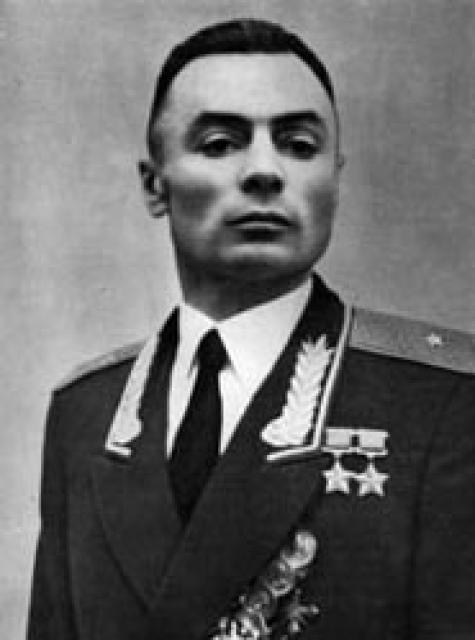
Vasiliy Petrov
 Ukraine
Biography of Vasily Petrov
Vasily Petrov, a Lieutenant General and twice Hero of the Soviet Union, showed great courage and military bravery while commanding artillery units during the Great Patriotic War. His units' artillery fire destroyed a significant amount of enemy military equipment and personnel. Petrov was wounded three times and lost both of his arms in the battles for the homeland. After recovering, he returned to his regiment and remained in service until the end of the war. Petrov's heroic actions were highly valued by his motherland. On December 24, 1943, he was awarded the title Hero of the Soviet Union, and on June 27, 1945, he was honored with a second Gold Star medal. He was also decorated with numerous other orders and medals. Vasily Petrov was born in a peasant family and was of Russian nationality. He became a member of the Communist Party of the Soviet Union in 1945. Petrov joined the Soviet Army in 1939 and began his service as a cadet at the 1st Sumy Artillery School, which he completed in 1941. After the war, he completed his education at Lviv State University through correspondence, defended his dissertation, and published a book titled "The Past With Us." Currently, Major General of Artillery Vasily Petrov continues his service in the Soviet Army. Doctors considered Vasily Petrov to be the most difficult and restless patient. He lay in a distant small ward, and people entered his room only when absolutely necessary, fearing his difficult nature. The patient would remain silent for whole days. Not only during the day, but also during the long sleepless nights, he sat on the bed and rocked himself until dawn. If a nurse or nanny entered, the patient would give them a prickly, dissatisfied look as if warning them not to linger. If someone turned on the phonograph, he would irritably say, "Can't we do without music?" He answered the doctors' questions briefly and reluctantly. And those who tried to "entertain" him, he grumpily cut off mid-sentence and turned away towards the window. Everyone could see that Major Petrov wrestled with bouts of dark melancholy and hopelessness, but no one knew how to help him. "You survived," said his hospital doctor, an elderly man with constant swelling under his eyes. "You could say you were lucky." Petrov looked at his bandaged shoulders and painfully twisted his dried lips - "lucky." "And what do I need life for?.. Without hands?! I'd rather have it straight in the heart - an end to all suffering!" "My dear, I'm seriously ill," the doctor admitted. "But as you can see, I'm still working, not giving up. There is nothing more valuable and beautiful than life. There is only one thing that worries me: I haven't done everything I could for my Motherland. But you have done it all. You are a lucky man." "Well, I did," Petrov said without joy. "You got the wrong address, doctor." "No, I'm not mistaken. I came to congratulate you because today it was announced on the radio that you have been awarded the high title of Hero of the Soviet Union. I came to congratulate you." The doctor left, and Petrov got up from the bed and paced the room. A great and important piece of news - he became a Hero of the Soviet Union. For what did his motherland award him with its highest honor? Of course, for crossing the Dnieper, for fighting tanks on the bridgehead. For the last battle of his life. But he could no longer hold a weapon. No hands... He lost them on the right bank of the Dnieper. That's where his life took a sharp turn. Essentially, his second life began. And the first... It was left behind. His memory took Petrov back to the early months of the war when he was a very young lieutenant. It is an interesting coincidence: the same city where the hospital is located was where he broke out of the encirclement. He broke out in full uniform, with weapons. A true soldier. That's how the colonel, now a marshal of artillery, described him and his comrades. But how much sorrow did he have to endure, how many clashes with the enemy, marching through swamps and forests, exhausting himself! He doesn't overestimate his willpower or character. It's not all about him - he had strong and resilient senior comrades by his side who inspired him with their words and personal example. In the days of the hardest trials, he met real people. And he became strong with them. At the age of twenty, Petrov was already commanding a battery. Fierce battles before Stary Oskol, Voronezh, Kharkov, and Lozova... Where his battery passed, there were disabled tanks, twisted machine guns, and enemy dugouts. On the battlefield, Petrov demanded as much from his soldiers as he did himself; he was the example he wanted to see in every soldier. Endurance and unwavering confidence in success never left the commander. In the hot battles on the Northern Donets River, Petrov's battery captured an enemy regiment. It held out in Kharkov until the last shell. Infantry neighbors retreated under Voronezh, but Petrov's artillerymen did not budge. Petrov led his battery across the river on ropes, and he himself crossed the burning bridge by car. ... This happened at the crossing. On the left bank, hidden in the river's floodplain forest, were columns of trucks, artillery, and combat engineer units... It seemed that every tree had military equipment and soldiers under it. The crossing was being bombed by enemy aircraft. Above was a clear blue sky, but on the ground - a terrible roar, clouds of thick dust, the groans of people. The bridge over the river was on fire. There was no way to extinguish the fire: enemy planes circled over the river, dropping bombs. Everyone could see that there was no way to go to the other side now. The road to the bridgehead was cut off. "Look, comrades, what they're doing!" someone exclaimed. People stood up and saw the following scene: an anti-tank gun was swimming across the river. It was moving across the water effortlessly, without human effort, and at first, it was unclear how it was moving. Then they noticed: it was hooked to hooks by ropes and pulled by a tractor from the other side. In the middle of the river, the gun disappeared into the water, emerged not far from the shore, and soon crawled up the steep slope. By the water, standing almost upright, was a tall, slender officer with a boyishly round face. He arranged this unusual crossing. Everyone on the shore thought that the loss of the bridge completely closed the way to the bridgehead, but he, an artillery officer, found a way. Ignoring the bombing, he continued to stand on the shore and gesture with his hand to the tractor driver. Looking at him, the driver did not lose his composure and calmly maneuvered the tractor. Apparently, the artillerymen had already crossed more than one gun using this method. "I've been fighting for the second year, but I've never seen such a crossing," the major among the sappers said. Fifteen minutes later, people saw the senior lieutenant again, but now he was at the burning bridge. He drove up to the bridge in a Gaz car. Everyone was waiting: what would the artilleryman do next? Together with the driver, he jumped into the river in his clothes, filled a canvas bucket with water, and, leaving a wet trail behind him, headed towards the car. His plan became clear: the senior lieutenant decided to drive the car across the burning bridge. Did he go crazy? He would die... Dozens of people rose from the ground and, forgetting about the whistling and thundering bombs, watched the artilleryman. Meanwhile, he, having poured water on the Gaz car, sat down next to the driver and waved his hand: let's go, as if saying. The car roared, rushed forward, accelerated at an angle, and at full speed rushed onto the burning bridge. On the shore, a heavy sigh seemed to pass. The Gaz disappeared in flames and smoke. Is it all over? No, the artilleryman is alive! The familiar Gaz popped out of the smoke and raced on at the same speed, catching up with the tractor that had disappeared into the forest. On the shore, in full growth, the major, pale from everything he had experienced, as if awakened and, shaking his head, summed up briefly: "A daring mind, but, I would say, not reckless. Did you see how confidently he acted? Calculation and courage - that is already the highest bravery." Many did not know at the time who this daring artilleryman was. Only later did it become known: it was Vasily Petrov. Himself, remembering the past, he says with a smile: "I was not going to die. It was visible to me: the right side of the bridge was on fire, and the left side was smoking slightly. There was a narrow strip left. It was a bit hot on the bridge, and it even burned a bit. But we made it through." His main character trait is willpower. It determined all his actions, giving him the courage and unwavering determination. His iron will helped him to hold his ground on the right bank of the Dnieper. It is not difficult to find the section where he crossed the Dnieper on the map - not far from Kremenchug, near the village of Shchuchenka. The situation here was so difficult that some officers even lost their bearings - it was impossible to approach the water. The enemy bombarded the left bank with shells, mines, and bombs. Neither day nor night did the intense fire stop. Time was not waiting - our paratroopers were already operating on the other side. The artillerymen had to support them with fire. The artillery commander ordered, "Petrov will be the first to open the way across the Dnieper." Two ferries set sail from the left bank of the Dnieper on a dark October night. The first two ferries carried artillerymen and cannons. They had not yet reached the middle of the river when it suddenly became bright - the Germans launched dozens of rockets. The small boats were as visible as the palm of one's hand. On the water, not in the forest: there is nowhere to hide. Enemy batteries immediately ceased fire. And the paratroopers had already swum to the right bank. Neither the Germans nor the Soviet troops saw it. They thought that the paratroopers were destroyed along with the ferries. The enemy's fire resumed with renewed intensity. The surviving enemy tanks launched another attack. One of the disabled tanks turned its turret. Petrov, standing at the gun, saw the danger, but it was too late. The shell exploded in front of the gun. Flames burned his eyes, something struck him hard. Petrov lost consciousness. After the battle, Private Pavlov found him among the dead. Both of the commander's hands were torn off, and his temple was covered in dried blood. Petrov regained consciousness only in the hospital... His comrades in arms punished him not to lose his spirits, his willpower, which he always possessed. Petrov understood that much in his condition depended on himself, on how he would perceive what had happened. The main thing was not to let misfortune and melancholy grow to destructive proportions. And Petrov gathered all his strength to fight himself. But one thing now saddened him: the doctors, and some comrades as well, looked at him as a hopeless invalid, who had only rest and reminiscing about the past left. Had he become completely out of the game? Of course, he could not handle various mechanisms anymore, he could not fix cars, guns, watches, typewriters, which he was skilled at before. He had "golden hands." Now they were gone. He could not shoot anymore (although he was an excellent marksman), solve artillery problems on a tablet. But he could do something! No, he did not consider himself a retired soldier, someone who had lost his place in line! One day, the doors of his ward opened wide, and Petrov saw his combat friends - officers Blokhin (he had just left the hospital, without even taking off his bandage), the chief of staff of the regiment Kulomin, and the scout Zapolsky. The room immediately became brighter - from warm smiles, enthusiastic greetings. The friends loudly recalled recent battles, comrades at the front. They spoke as if nothing had happened - just separated for a short time, that's all. "Well, Vasily Stepanovich, isn't it time to go back home?" Kulomin asked. "We see that you are already on your feet. The whole regiment is waiting for you." "Waiting?" Petrov asked in surprise. "Yes, waiting. Everyone hopes that you will join the regiment again. And the brigade commander believes so and asked me to convey this to you. It seems the choice is up to you." "According to you, will I still be able to fight?" Petrov asked softly. "It's not just one person fighting with hands," they exclaimed together. Petrov breathed a sigh of relief and joy. They are calling him back to duty. His combat comrades are waiting for him. For the sake of this alone, one can live in this world! Once again, he felt the same hopes, aspirations, and joys. He internally dealt with everything that tormented and suppressed him and felt that his second life would be a fighting one, active. "Thank you, friends," he smiled happily. "I'm ready to return."