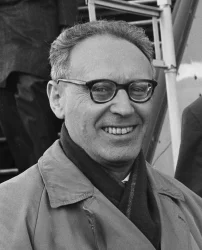
Vasily Smyslov
- Early Life and Two Passions
- The Road to the World Championship
- A Long Competitive Career
- Personal Life and Legacy
Vasily Smyslov combined a calm, deeply intuitive chess style with a life-long love of music. He became the seventh World Chess Champion in 1957, then spent decades competing against younger generations of stars. His career reached an extraordinary late peak when, at 63, he advanced to the final match of the 1984 Candidates cycle.
Early Life and Two Passions
Born in Moscow on March 24, 1921, Smyslov learned chess from his father, Vasily Osipovich, a strong player who introduced him to the game when he was six. The boy began competing as a teenager and quickly showed a talent for seeing how pieces could work together across the whole board. His style would become known for its positional clarity and endgame precision, though his games could also produce startling tactical turns.
Chess was not his only ambition. Smyslov had a rich baritone voice and seriously pursued singing. In 1950, while already an elite chess player, he entered a national competition for a position at the Bolshoi Theatre and reached the final shortlist, but was not selected. He continued to sing throughout his life, sometimes giving recitals with pianist and fellow chess grandmaster Mark Taimanov.
The Road to the World Championship
Smyslov rose rapidly in Soviet chess after World War II. He finished second in the 1948 world championship tournament, which determined the successor to the late Alexander Alekhine, and established himself as Mikhail Botvinnik’s most persistent challenger. Winning the 1953 Candidates Tournament in Zurich earned him his first world championship match against Botvinnik. Their 1954 contest ended in a 12–12 draw, allowing the reigning champion to keep the title.
Smyslov returned to the Candidates Tournament in 1956 and won again. In their 1957 rematch, he defeated Botvinnik by 12½–9½ to claim the world title. The victory crowned years of steady pressure against one of the game’s most formidable champions. Under the rules of the time, Botvinnik had the right to a return match. In 1958 he regained the title, defeating Smyslov 12½–10½.
A Long Competitive Career
Losing the crown did not end Smyslov’s influence. He remained among the world’s strongest players for years, returning to the Candidates cycle and competing in major international events. He was admired for a style that could make difficult positions look natural: patient development, exact calculation, and an exceptional ability to convert small advantages in the endgame.
His later challenge was remarkable for its longevity. After finishing second at the 1982 Las Palmas Interzonal, he advanced through the Candidates matches and reached the 1984 final against Garry Kasparov. Smyslov was nearly 63, while Kasparov was a rising 21-year-old. Kasparov won the match, but Smyslov’s run became one of the most striking late-career achievements in world championship chess.
In 1991, at age 70, Smyslov won the inaugural FIDE Senior World Championship. It was a fitting coda to a career that had spanned generations of players and dramatic changes in competitive chess.
Personal Life and Legacy
Smyslov died in Moscow on March 27, 2010, three days after his 89th birthday. His reputation rests on more than the year he held the world title. The seven-time Soviet Olympiad competitor was a perennial top-level presence, a champion whose games remain models of coordination and endgame technique, and an accomplished singer who continued to nurture his second art alongside chess.