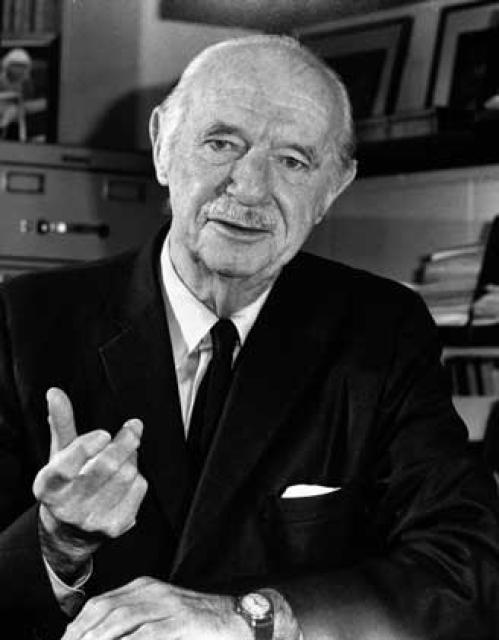
Vinsent du Vigneaud
 USA
- From Chicago to Biochemistry
- Research Across Sulfur Chemistry and Hormones
- The 1955 Nobel Prize and Later Years
Vincent du Vigneaud was an American biochemist whose work connected the molecular structure of hormones to their effects in the body. By tracing the role of sulfur in biological molecules, he helped clarify the chemistry of insulin, biotin, and pituitary hormones. In 1955 he received the Nobel Prize in Chemistry for research on important sulfur compounds and for achieving the first synthesis of a polypeptide hormone: oxytocin.
From Chicago to Biochemistry
Du Vigneaud was born in Chicago on May 18, 1901, to Mary Theresa O’Leary and Alfred Joseph du Vigneaud, an inventor and machine designer. After high school he considered farming, but his interest in chemistry—and encouragement from his family, particularly his older sister—led him to the University of Illinois. He earned bachelor’s and master’s degrees in chemistry there in 1923 and 1924, supporting himself with jobs that included waiting tables.
At Illinois, biochemists H. B. Lewis and W. C. Rose helped draw his attention to the chemistry of living systems. He pursued doctoral research on insulin at the University of Rochester, earning a Ph.D. in biochemistry in 1927. The molecule’s sulfur content became a lasting thread in his work. A National Research Council fellowship took him to Johns Hopkins, followed by research visits to Dresden and Edinburgh, where he broadened his experience in biochemical research.
Du Vigneaud married Zella Zon Ford, whom he had met while both were students, in 1924. They had two children, Vincent Jr. and Marilyn. The couple remained close through his long research career and his later illness.
Research Across Sulfur Chemistry and Hormones
After returning to the United States, du Vigneaud held appointments at the University of Illinois and the University of Pennsylvania before becoming head of biochemistry at George Washington University’s medical school in 1932. In 1938 he moved to Cornell University Medical College in New York, where he led its biochemistry department for nearly three decades. He built a research program that combined careful chemical analysis with the demanding task of making biological compounds in the laboratory.
His investigations followed sulfur through molecules such as cysteine and insulin, and extended to amino-acid metabolism, transmethylation, and the vitamin biotin. During World War II, he and colleagues also worked on penicillin, contributing to efforts to understand and synthesize the urgently needed antibiotic.
The achievement most closely associated with du Vigneaud came from his studies of the posterior pituitary hormones oxytocin and vasopressin. Oxytocin helps stimulate uterine contractions during childbirth and milk release during lactation; vasopressin helps regulate the body’s water balance. His team worked out the structures of these small peptide hormones and developed methods to assemble their amino-acid building blocks in the correct order. In 1953, the group reported the synthesis of oxytocin, demonstrating that a biologically active polypeptide hormone could be constructed chemically.
The 1955 Nobel Prize and Later Years
The Nobel Prize in Chemistry recognized du Vigneaud’s research on biochemically important sulfur compounds, especially the first synthesis of a polypeptide hormone. The award brought international attention to peptide chemistry and the possibility of investigating biological molecules by building them step by step. He also received the Lasker Award in 1948 and several major scientific honors.
After retiring from his New York department chair in 1967, du Vigneaud moved his laboratory to Cornell’s Ithaca campus and continued research on the relationship between chemical structure and biological activity. A severe stroke in 1974 ended his active scientific work. He died in White Plains, New York, on December 11, 1978, aged 77; his wife had died the year before.
Du Vigneaud’s legacy lies in the experimental path he opened between chemistry and physiology. His work showed that a hormone’s precise sequence of amino acids could be determined and reproduced, giving scientists a powerful way to study how molecular structure shapes biological activity. The synthesis of oxytocin remains a landmark in peptide chemistry, while his broader research helped establish sulfur chemistry as a central part of modern biochemistry.




