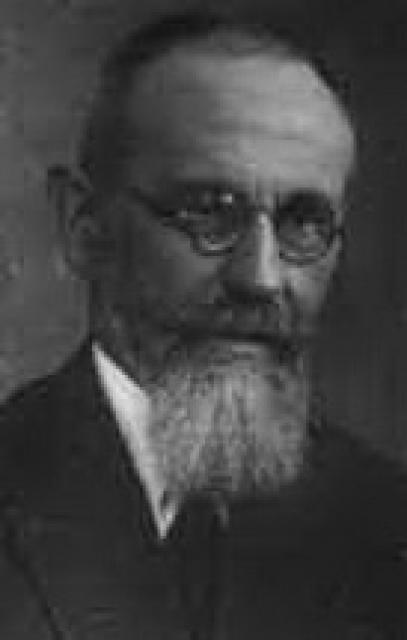
Vladimir Dehn
Vladimir Eduardovich Den
Early Life and EducationVladimir Eduardovich Den was born into a family of German origin in the city of Reval (present-day Tallinn, Estonia) in 1869. His father, Eduard Alexandrovich Den, was a general-lieutenant in the Russian army.
In 1890, Den graduated from the law faculty of Moscow University. He then pursued further studies in Germany for two years. In 1894, he returned to Moscow University and obtained a master's degree in political economy, statistics, and financial law.
Academic Career
Den began his career in 1898 as a docent (assistant professor) at Moscow University, where he taught courses in economic history and the history of trade. In 1902, he moved to St. Petersburg and founded the first chair of economic geography in Russia at the Polytechnic Institute.
Den developed a scientific school known as the "industry-statistical" school, which used quantitative statistical methods to analyze the location and functioning of economic objects. He advocated for an industry-based approach to geographical research.
Conflict and Controversy
In the 1920s, Den's industry-statistical school became embroiled in a controversy with proponents of the "regional approach" led by figures such as S.V. Bernstein-Kogan and N.N. Baransky.
In the early 1930s, the Stalinist regime began a systematic campaign to suppress Den's scientific direction. His successor as head of the economic geography department, Heinrich Möbus, committed suicide after being summoned for interrogation.
Repression and Legacy
Den's works were banned and his views were denounced as erroneous and harmful. His son was arrested on fabricated charges, and his students and former colleagues were subjected to repression or forced to abandon their previous beliefs.
Despite his contributions to the field, Den's writings were not republished until 1949, and his legacy was largely forgotten. However, in recent years, there has been a renewed interest in his work and its significance in the history of economic geography.


