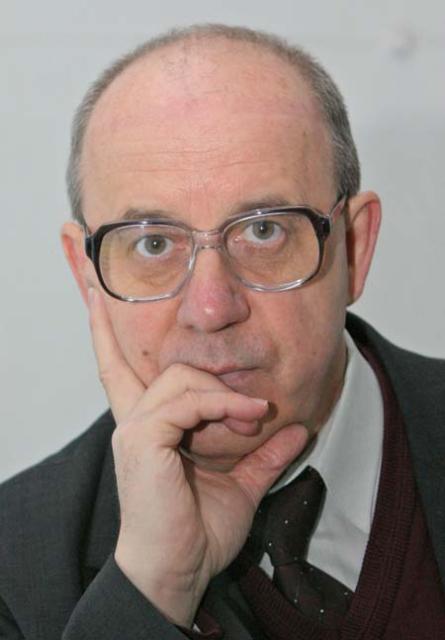
Vyacheslav Kuvshinov
 Belarus
Early Life and Education
Vyacheslav Kuyshinov was born in Khmelnytsky, Ukraine, in 1952. His father's military career led the family to reside in various locations throughout the USSR, including Moscow and Kaliningrad. In 1963, Kuyshinov enrolled in the Physics Faculty of Belarusian State University (BSU). After graduating, he pursued his postgraduate studies at the Institute of Physics, National Academy of Sciences of Belarus (NASB).
Academic Career
In 1974, Kuyshinov defended his candidate dissertation on "Nonlinear Equations of Electrodynamics of Scalar Mesons." In 1989, he received his doctoral degree for his dissertation on "Invariant Cubic Forms for Action Functionals of Gauge Models and Correlations of Hadrons in Multiple Production Processes."
From 1975 to 1987, Kuyshinov served as Scientific Secretary of the Department of Physical and Mathematical Sciences of NASB. He headed the Laboratory of Strong Interactions from 1998 to 2004. In 1993, he became a Professor at BSU. Under his guidance, one doctoral and eight candidate dissertations were successfully defended.
Leadership at JINR Dubna
In 2004, Kuyshinov was appointed Director-General of the Joint Institute for Power and Nuclear Research "Sosny" (JINR Dubna). He simultaneously continued lecturing at BSU. Kuyshinov is a member of the CMS collaboration at the LHC accelerator, the Coordinating Council for Cooperation with JINR Dubna, and the Editor-in-Chief of the international scientific journal "Nonlinear Phenomena In Complex Systems."
Scientific Contributions
Kuyshinov's research focuses on nuclear physics, the theory of strong interactions, and nonlinear dynamics of complex systems. He developed a theory of non-perturbative fluctuations of the gluon field (instantons) in the nucleus and its squeezed and entangled states. Kuyshinov's work also includes the generalization of the Ginzburg-Landau theory of phase transitions, the first description of correlation properties of quark-gluon plasma, and the prediction of temperature hysteresis. These approaches have potential applications in the study of high-temperature superconductors.


