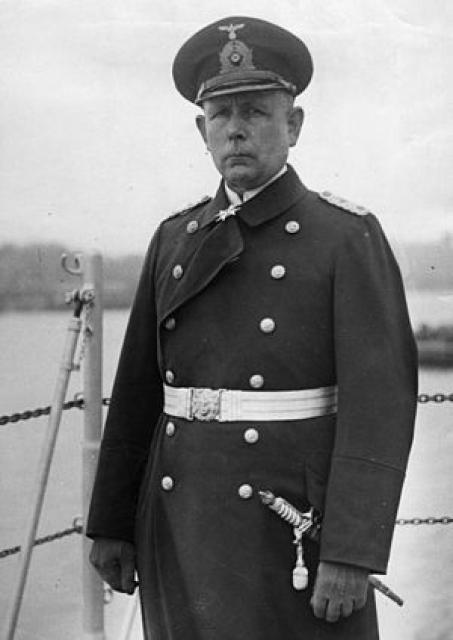
Wilhelm Marshall
 Germany
- Marshall, Wilhelm
- Interwar Years
- World War II
- Norwegian Campaign and Controversy
- Retirement and Vindication
- Post-War Life and Legacy
Marshall, Wilhelm
1886-1976Early Life and Naval Career
Wilhelm Marshall was born on September 30, 1886, in Darmstadt, Germany. In 1906, he joined the Imperial German Navy as a cadet. He became an officer three years later and served on various ships, including the latest battleships. In 1916, Marshall was assigned to the submarine school.
During the last two years of World War I, Marshall commanded the UC-74 and UB-105 submarines, sinking several Allied vessels. He was awarded the prestigious Pour le Mérite medal on July 4, 1918.
Interwar Years
After the war, Marshall served as Chief of Staff of Naval Operations, commanded the battleship Hessen and the pocket battleship Admiral Scheer. By the outbreak of World War II, he had assumed command of all pocket battleships.
World War II
On October 21, 1939, Vice Admiral Marshall became Commander-in-Chief of the Fleet, replacing Admiral Hermann Boehm. On November 21, 1939, he sailed with the battleships Scharnhorst and Gneisenau to operate in the area between Iceland and the Faroe Islands. The goal was to simulate a breakout of raiders into the Atlantic, destroy British naval forces guarding the Faeroe-Iceland Gap, and cover the return of the pocket battleship Deutschland after its Atlantic raid.
The operation was a success. The ships undetectedly entered the designated area. On November 23, they sank the British armed merchant vessel Rawalpindi, which managed to transmit a message about the presence of two battleships. The British command dispatched the entire Home Fleet to intercept them, along with several French ships.
Marshall, aware of this, sailed north to avoid enemy aircraft, especially after sighting a suspicious silhouette on the horizon. The ships remained in a precarious position for a day until receiving word of an approaching storm. On November 26, Marshall summoned the squadron's meteorologist, who provided a weather forecast. Based on this, the squadron took cover in a rain zone off the Norwegian coast. The British fleet never located them.
As planned by Marshall, he managed to draw the enemy away and then successfully escape pursuit. It later emerged that the aim of the raid was achieved: the British began including battleships in their convoys, dispersing their forces.
However, Raeder was furious when he learned that Marshall had declined to attack the sighted ship on November 23. Marshall's actions were justified, as attacking an unknown vessel at night while British Home Fleet ships were nearby was risky. Marshall himself wrote: "Up to now, the axiom that large ships should avoid any contact with enemy destroyers and reconnaissance forces at night has never been questioned."
Despite his own prohibition against exposing capital ships to risk, Raeder, as Commander-in-Chief of the Navy, was displeased. He never directly expressed his disapproval to Marshall, depriving him of the opportunity to defend himself. Instead, he ensured that his remarks reached the fleet commander.
Norwegian Campaign and Controversy
During the Norwegian Campaign, Raeder ordered Marshall to sail with his squadron and bombard the British naval base at Harstad to assist German troops at Narvik. Following Hitler's instructions, Raeder also ordered Marshall to provide flank cover for the advance of General Eduard Dietl's forces from Trondheim northward to rescue the besieged Narvik group.
When Marshall requested clarification on which order to execute, Raeder responded, "Both." Marshall's squadron, consisting of the battleships Scharnhorst, Gneisenau, heavy cruiser Admiral Hipper, four destroyers, and the tanker Dithmarschen, set off at full speed for Narvik. They left the North Sea undetected.
At a command briefing while the destroyers refueled, Marshall issued orders for breaking into Vågsfjord and shelling Harstad. However, after receiving aerial reconnaissance reports indicating that only one gunboat remained in Harstad, he decided against attacking the port.
On the night of June 7, the admiral received aerial reconnaissance reports of three British convoys leaving Narvik, concluding that the British were evacuating the town. He immediately informed headquarters of his intention to attack these tempting targets at sea.
However, Raeder and Generaladmiral Hermann Boehm, commander of Group West, disagreed. At 5 a.m. on June 8, they ordered Marshall to stick to the primary mission of attacking the Harstad base. The order to provide flank cover for Dietl was not rescinded.
Nevertheless, Marshall proceeded with his larger ships to intercept the convoys. By that time, the British had already evacuated most of their troops from Narvik between July 4 and 8. The German ships caught the last of the vessels. Hipper sank the escort tra掃er Juniper, the Norwegian tanker Oil Pioneer, and the empty troop transport Orama.
After sending the cruiser and destroyers to refuel and provide flank cover for Dietl, Marshall sailed north with the remaining ships to where British aircraft carriers Ark Royal, Glorious, and cruiser Southampton were believed to be located. Around 1700 hours, Scharnhorst spotted Glorious and opened fire from a range of 26 kilometers. Gneisenau soon joined the attack.
The aircraft carrier sank within two hours. The escorting destroyers Ardent and Acasta also went down, but not before the latter managed to fire four torpedoes. One struck Scharnhorst, causing significant damage. Marshall had to halt the pursuit of the convoy and return to Trondheim for repairs.
Despite this notable success, Marshall received no praise from Raeder, who believed the squadron's primary duty was to attack Harstad.
Retirement and Vindication
Amid tensions with the command, Marshall declared himself ill on June 18 and was replaced by the more compliant Vice Admiral Günther Lütjens. The offended admiral demanded a court of inquiry into his conduct during the "Juno" operation, as the Norwegian expedition was codenamed. However, Raeder prevented his subordinate from clearing his name.
In late August 1940, Raeder recalled Marshall from retirement and appointed him Inspector of Naval Education. From late 1941 to May 1942, the admiral carried out special duties with Army Groups South and East, but he no longer received an appointment commensurate with his rank. He eventually retreated into a semi-retired status.
On August 12, 1942, Raeder placed Marshall in command of the forces in France, and six weeks later, the admiral became head of Army Group West with headquarters in Paris. While promoting the admiral, Raeder simultaneously prevented him from justifying his actions in Norway.
Generaladmiral Marshall retired during the first days of Dönitz's rule. In 1943, he was again called up and made Chief of a special staff for the Danube area. After another retirement, Marshall resumed command of Army Group West from April 19, 1945, and held the post until the war's end.
Post-War Life and Legacy
The Allies released Marshall from prison in mid-1947. He wrote several articles on naval history and strategy. Notably, his book on World War II, published in Stuttgart in 1957, was translated into Russian and widely distributed.
Marshall remained an influential figure in German naval circles. He was a respected strategist and tactician who faced challenges and adversity throughout his career due to power struggles and personal animosity within the German Navy's leadership. Nevertheless, his contributions to German naval history and strategy are undeniable.