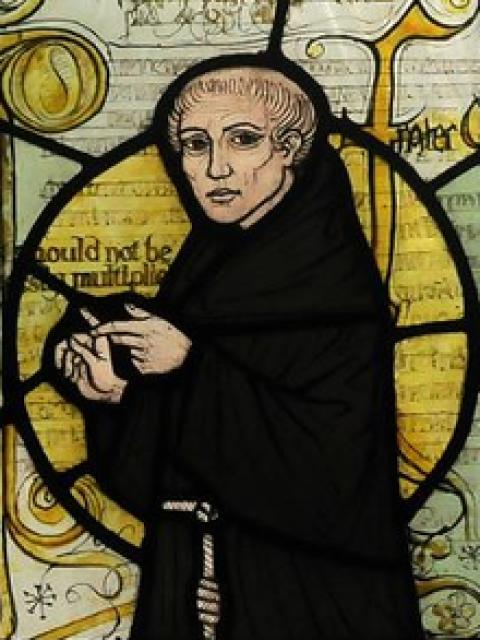
William Occam
 Great Britain
William of Ockham was an English Franciscan friar, philosopher, theologian, and political writer whose arguments helped shape late medieval thought. He is especially associated with a principle often called “Ockham’s razor”: when reasoning about a problem, do not multiply assumptions beyond what is needed. His writings also challenged prevailing accounts of universals and examined the limits of papal authority. His exact birth and death dates are uncertain; he is generally placed around 1287 to 1347.
Early life and study
Ockham was born in the village of Ockham in Surrey, England. He entered the Franciscan order as a young man and studied theology at Oxford. By the late 1310s, he had completed the work required for the degree of master of theology, including lectures on Peter Lombard’s “Sentences,” a central text in medieval theological education.
He became known as an incisive teacher and commentator on logic, Aristotle, and theology. Ockham’s style was marked by careful distinctions and a preference for explaining arguments with as few unsupported assumptions as possible. The familiar label “Ockham’s razor” came later, but it summarizes one important strand in his method; it should not be mistaken for a rule that the simplest answer is always true.
Philosophy and logic
One of Ockham’s central philosophical concerns was the status of universals: ideas such as “humanity” or “redness” that seem to apply to many particular things. Against theories that treated universals as real entities existing independently of individual objects, Ockham argued that only individual things exist outside the mind. General concepts and words allow people to think and speak about many individuals together.
This approach, often associated with nominalism, influenced later debates in philosophy and theology. Ockham also wrote extensively on logic, language, knowledge, and natural philosophy. His “Summa Logicae” became one of his major works, setting out his account of terms and reasoning.
Conflict with the papacy
Ockham’s life changed when he was summoned to the papal court at Avignon around 1324 to answer questions about his theological writings. There, he became involved in a dispute between the Franciscan order and Pope John XXII over apostolic poverty: whether Christ and the apostles had owned property, and what kind of poverty the Franciscan order was bound to practice.
In 1328, Ockham left Avignon with the Franciscan minister general Michael of Cesena and sought protection from Louis of Bavaria, the rival claimant to the imperial title. Ockham remained in the emperor’s circle, eventually settling in Munich. He wrote polemical works on church and state, arguing against the pope’s claims to unrestricted authority. His later writings linked disputes about religious poverty to broader questions about political power, law, and the rights of rulers and communities.
Legacy
Ockham’s work stands at the intersection of medieval theology, philosophy, and politics. His arguments about universals became a lasting reference point in metaphysics, while his treatment of logic influenced the study of language and reasoning. His political writings also helped make him one of the most notable critics of papal power in the fourteenth century.
The name “Ockham’s razor” remains widely used, though the historical thinker’s contribution was broader than that slogan. He developed a rigorous way of testing explanations and concepts, and his influence continues to be discussed in the history of philosophy.