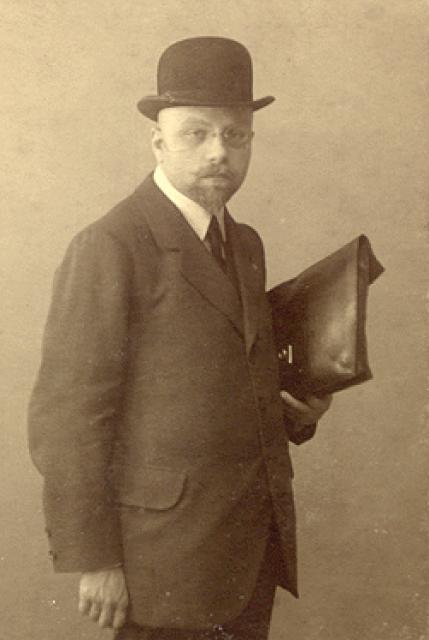
Yakob Haan
 Israel
- Biography of Jacob Israël de Haan
- Early Life and Career
- Interest in Judaism and Zionism
- Life in Palestine
Biography of Jacob Israël de Haan
Jacob Israël de Haan was a Jewish political figure in Mandatory Palestine, born in the Netherlands. He was also widely known in his homeland as a journalist and poet. De Haan was born in Kloosterveen, a village in the province of Drenthe, and grew up in Zaandam. He was the youngest of eight children and received a traditional Jewish education. His father, Itzhak Ha-Levi de Haan, was a synagogue cantor. De Haan's sister was a writer who primarily wrote under the pseudonym "Kerri van Bruggen."
Early Life and Career
Between 1903 and 1909, de Haan studied law and worked as a teacher. During this time, he wrote for socialist journals and corresponded with the famous Dutch writer Frederik van Eeden. In 1901, he moved to Amsterdam, where he wrote the novel "Pijpelijntjes" (1904), named after his new neighbor in the De Pijp district. This novel prominently featured homoerotic themes, causing sharp public controversy and outrage. As a result, de Haan was forced to leave the socialist circles that had rejected him. He married Johanna van Maarsveld in 1907, although their marriage was likely platonic. They separated in 1919 but never officially divorced.
Interest in Judaism and Zionism
Around 1910, de Haan began to take an interest in Judaism, Israel, and Zionism. This interest was likely sparked by the imprisonment of many Jews in Tsarist Russia on suspicion of Bolshevism and his diplomatic efforts to secure their release. Historians believe that de Haan traveled to Russia with a letter of recommendation from Queen Wilhelmina of the Netherlands and was able to negotiate some alleviation of the Jews' imprisonment conditions. His diplomatic work to improve the situation of Russian Jews continued for two years and made him a great connoisseur of anti-Semitism.
Life in Palestine
After World War I, de Haan moved to Palestine with a strong desire to contribute to the realization of Zionist ideas. In the early years in Palestine, he worked as a correspondent for the Amsterdam newspaper "Algemeen Handelsblad" and the London "Daily Express." During this time, he met Leopold Weiss (Muhammad Asad), another well-known Jewish dissident and politician, with whom he shared doubts about life, particularly Zionism. Disillusioned with the Zionist movement, de Haan met Rabbi Joseph Chaim Zonnenfeld, the leader of the anti-Zionist faction of the old Jewish community, and became his secretary. Thanks to his social connections, de Haan was able to establish contacts between Zonnenfeld and high-level diplomatic institutions, including the League of Nations and Emir Abdullah of Transjordan. De Haan attempted to negotiate separate agreements with the Arabs and the British on behalf of the Edah HaChareidis, circumventing the Zionist leadership. His activities soon caused confusion and then threats to cease his work. De Haan staunchly refused, and on the night of June 30th to July 1st, 1924, he was shot on the doorstep of the Shaare Zedek hospital synagogue in Jerusalem by activists from the Jewish underground movement Haganah, later revealed to be Avraham Tehomi, under orders from the highest leadership of Haganah.