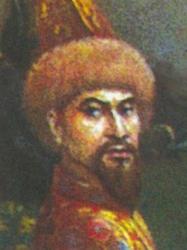
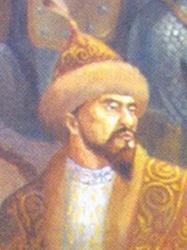
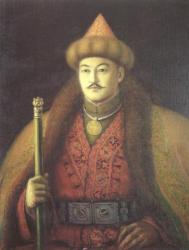
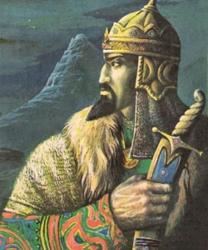
Ablai Khan
 Uzbekistan
Biography of Abulkhair Khan
Abulkhair Khan was a Kazakh khan and one of the most famous khans of the Middle Horde. He was born in 1711 to Korkem Wali-Sultan and was the grandson of Abulai Khan Kanshara, as well as a descendant of Barak Khan. Abulkhair Khan played a significant role in the period of the Dzungar invasion, uniting the forces of three Kazakh hordes to fight against the invaders.
Early Life and Rise to Power
Abulkhair Khan, whose real name was Abulmansur, became an orphan at a young age. It is noted that in 1725, under the name "Sabalak," he herded camels in the Karakamys region, 10 versts from Tashkent. He gained recognition among the people when he joined the militia organized by Abulmambet, who also descended from Esim Khan and Zhangir Khan. Abulkhair Khan defeated the Dzungar warrior Sharysh under the battle cry "Ablai." Impressed by Abulkhair's bravery, Abulmambet embraced him and proclaimed his potential to become a great khan. With the approval of 90 esteemed representatives from the three hordes, Abulkhair Khan was chosen as the supreme khan.
Reign and Diplomacy
Abulkhair Khan ascended to the throne at the age of 25, following a non-traditional succession process. Instead of residing in the Senior Horde, he relocated the khan's camp to the Middle Horde, which bore the brunt of the war against the Dzungars. Abulkhair Khan believed it was logical for the supreme khan to lead and establish his camp in the Middle Horde. He showed great respect for Tole Biy, the spiritual leader of the Senior Horde, and gained his approval for the relocation.
Apart from his personal courage and ability to unite influential leaders from each horde, Abulkhair Khan excelled as a diplomat and politician. He successfully balanced relations with the neighboring powers of China and Russia, ultimately eliminating the threat of Dzungar attacks. After the Dzungars' devastating defeat by China in 1757, Abulkhair took advantage of the situation and effectively brought an end to their domination. In 1757, he traveled to Beijing, accompanied by his son Abulfayz, where he pledged allegiance to the Chinese emperor as a "vassal prince," maintaining his autonomy while paying tribute.
In 1765, Abulkhair Khan signed a treaty with Russia. However, he refused to recognize the decision of the Russian government in 1778 to grant him the title of Grand Khan. He believed that his position as khan was bestowed upon him by the people and therefore he was not obligated to swear allegiance to the Russians. This stance reflected his commitment to preserving the sovereignty of the Kazakh Khanate.
Legacy and Death
Abulkhair Khan's vision of a united Kazakh territory, including Tashkent, and his plans for cultural and economic progress faced resistance. Centrifugal motives and conservative ambitions had always been detrimental to the fate of the Kazakh people. Despite Abulkhair's efforts, these motives persisted.
Eventually, the same conservative ambitions that led to his rise to power forced Abulkhair Khan into retirement. He retired to the Senior Horde and passed away in May 1781 in Tashkent. He was buried in the mausoleum of the revered Kazakh figure, Hodja Ahmed Yassawi, a sacred shrine for the Kazakh people.