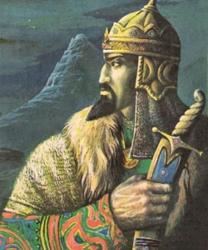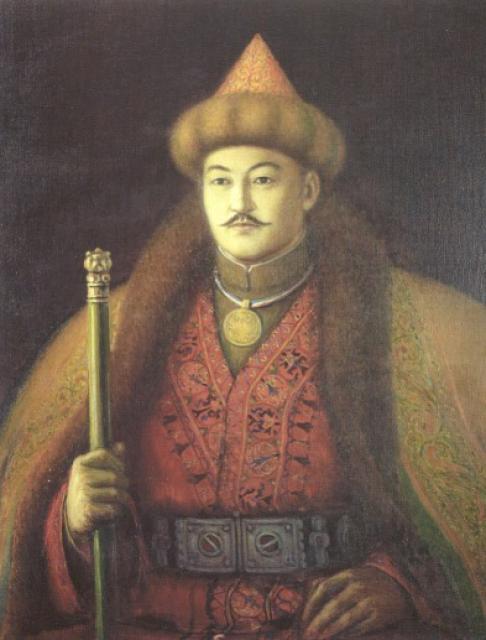
Dzangir han
 Kazakhstan
- Biography of Zhanyr Khan
- Early Life and Rise to Power
- Political Struggles and Military Campaigns
- The Battle of Orbulaq and Later Years
Biography of Zhanyr Khan
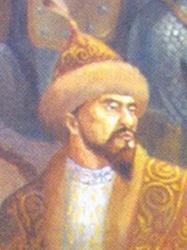
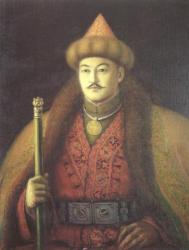
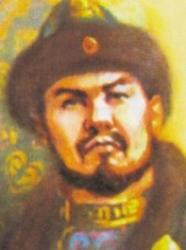
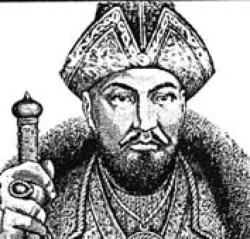
Zhanyr Khan was a prominent statesman and outstanding military leader during his reign from 1628 to 1652. He was buried in Turkestan, near the Haji Ahmed Yassawi Mosque, in recognition of his achievements. Later, a mausoleum was erected over his grave, but it has not survived to this day.
Early Life and Rise to Power
The exact date of Zhanyr Khan's proclamation as the Khan is unknown, and there are no reliable records of his birth year. According to some sources, he was raised on the white felt immediately after his father's death in 1628. However, it took some time for him to be recognized as the supreme Khan of the Kazakhs. He faced similar challenges as his father, Esim Khan, in regaining the title of Khan after being detached from real power. Like his father, Zhanyr Khan was concerned about the "Dzungar threat." These concerns heightened after the rise of Batyr-huntaychi (1635-1654), who established a strong centralized state in Dzungaria.
Political Struggles and Military Campaigns
During Zhanyr Khan's time, the Kazakh Khanate was embroiled in internal conflicts. Each representative of the Chingizid dynasty claimed supreme power, and attempts by the sultans to strengthen their political influence met fierce resistance from the biys, who also sought to increase their role. This constant political struggle hindered the growth of Zhanyr Khan's power, as he constantly had to prove his inherited right to rule.
In 1635, Zhanyr Khan was captured by the Jungars during one of the battles. He was later freed by the Kazakh militia, but his return home was a significant trial for him. The captivity and humiliating release temporarily undermined his political authority among the sultans, who tried to discredit him in the eyes of the general population. However, Zhanyr Khan proved to be above all facts and events. As many historical documents indicate, he maintained an alliance with the Mughal rulers, continuing the political traditions established by his father. His son, Tauke, played an active role in implementing foreign policies. Zhanyr Khan also had friendly relations with the ruler of Samarkand, Zhantos Bakhtur (1576-1656). Their alliance was a response to Batyr's coalition, which aimed to invade the Semirechye region.
The Battle of Orbulaq and Later Years
Zhanyr Khan's concerns were confirmed in 1643 when Batyr, gathering an army, captured some lands in the southern and southeastern slopes of the Tian Shan mountains. Upon learning of this, Zhanyr Khan decided to confront the enemy's army despite its significant superiority, leading only a small militia of 600 men. For the battle, Zhanyr Khan chose a mountainous location near the Or River and employed trench warfare tactics. Researchers who have closely studied the site of this famous battle note that Zhanyr Khan employed several complex tactics from the Kazakh military art, as well as uncommon methods of dividing the enemy's forces. The battle led to the Jungars losing a significant number of soldiers (around 10,000) and being forced to retreat under the pressure of the Samarkand troops led by Zhantos Bakhtur. The Battle of Orbulaq showcased the bravery, heroism, and incredible military prowess of the Kazakhs, solidifying its place in the world's chronicles of combat glory. The success of this battle was primarily determined by Zhanyr Khan's military skills.
However, military clashes continued, and the victories were inconsistent. For some time, the Jungars even controlled the eastern part of the Semirechye region. In 1652, Khoshuut leader Tsegen Khan launched campaigns into Kazakh uluses, and it was in one of these battles that Zhanyr Khan was killed by Tsegen's son, Galdam.
In recognition of Zhanyr Khan's merits, he was buried in Turkestan near the Haji Ahmed Yassawi Mosque. Later, a mausoleum was built over his grave, but unfortunately, it did not survive to the present day.