Kenesary Kasymov
 Kazakhstan
- Biography of Kenesary Kasymov
- The Impressive Life and Deeds of Kenesary Kasymov
- Kenesary's Legacy
- Kenesary's Character
Biography of Kenesary Kasymov
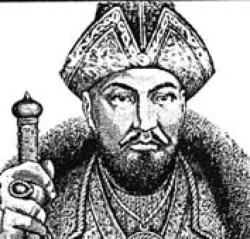
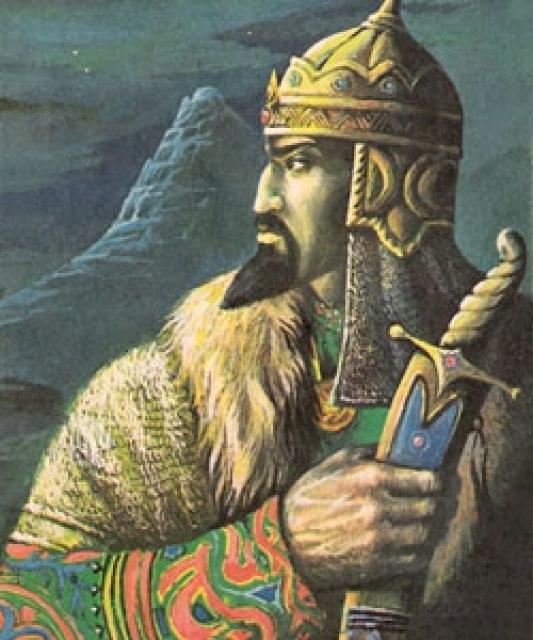
Kenesary Kasymov was a Kazakh sultan, the khan of the Middle Juz, and the leader of the anti-colonial uprising in Kazakhstan. He was born in 1802 and died in 1847. Kenesary belonged to the upper echelons of the nomadic nobility and sought to restore the han's authority that had been abolished by the Russian government. The social base of Kenesary's movement consisted of disgruntled feudal lords who were dissatisfied with the expansionist policies of neighboring states and the elimination of han's power. The core of his army consisted of his close relatives, while his main military force consisted of his clan's warriors and their retinues. In 1841, at a gathering of Kazakh tribal nobility and sultans, Kenesary Kasymov was proclaimed khan. He reinstated the bievs court, which settled disputes according to Sharia law. Through his tax policies, Kenesary upheld the norms of Islamic law, introducing the zyaket tax for pastoral regions (levied on livestock breeders in favor of the khan and sultan) and the ushur tax for agricultural areas (levied on settled population). Kenesary's despotism, considering the Kazakh juzes as his hereditary possession, caused resentment among the people, who began openly opposing him. In 1844, the Jappas clan revolted against Sultan Nauryzbay, Kenesary's brother, who had come to their villages with a detachment of esauls, demanding zyaket, confiscating property and goods, and taking women and girls. The Jappas clan took up arms against the Sultan Nauryzbay and his supporters. Kenesary pursued the same policies as his grandfather Ablai, believing that only cruelty could make the han's power strong. He maintained his authority through strict discipline, sometimes bordering on terror. On the lands he conquered, Kenesary established a dynastic regime. By the end of 1846, Kenesary was pushed out of the territories of the Junior and Middle Juz by Russian imperial forces and Kazakh sultans-rulers' military formations. He took refuge on the inaccessible peninsula at the mouth of the Ili River and launched raids on Kyrgyz lands. The acceptance of Russian citizenship by the Kazakhs of the Middle Juz in 1846 significantly weakened Kenesary's position in Semirechye, as he had always advocated for the separation of Kazakhstan from Russia. Deprived of any significant social support within the Middle Juz, Kenesary left its borders in 1847, hoping to improve his position through conquests in Kyrgyzstan, but was captured and executed in one of the battles.
The Impressive Life and Deeds of Kenesary Kasymov
The most striking aspect of Kenesary Kasymov's life and deeds is his tragedy. Despair and inevitability are intertwined with his actions, characterized by courage, determination, and the ability to confront fate and challenge time. Kenesary stood at the forefront of the struggle for the revival of Kazakhstan's independent statehood. His great contributions lie in his fight against imperial policies, for the freedom of the Kazakh people, and for the affirmation of their honor and dignity. The spiritual lessons of his political legacy are particularly significant in the contemporary processes of developing independent statehood. Kenesary's aspirations and yearnings, though limited in the conditions of that time, had a universal character. The uprising of the Kazakhs from 1837 to 1846, led by Khan Kenesary, was a just act - a protest aimed at resisting the expansionist colonial policies of the Russian Empire, the Khanate of Kokand, and the Khanate of Khiva. It had a national-liberation character with the goal of restoring statehood and preserving the territorial integrity of the ancestral land of the Kazakhs. As the leader of the movement and a passionate patriot of his homeland, Kenesary Kasymov proved himself to be an outstanding statesman, a remarkable military leader, and a gifted diplomat of his time, dedicating his life to the struggle for freedom and independence.
Kenesary's Legacy
Kenesary's keen vision recognized the changing policies of the Tsarist government, which had shifted from patronage and vassalage in relations between Russia and Kazakhstan to direct colonization in the 19th century. He linked the focus of his diplomatic and political activities to the agreement of the Tsarist government to destroy the military-administrative centers and outposts that were being forcefully established at that time, severing the organic sovereignty of the Kazakh people. Kenesary's movement was a desperate, essentially tragic attempt to unite the people and preserve statehood, even within the framework of a vassal dependency. That is why, as Buketov noted, his fame overshadowed even the reputation of the popular Khan Ablai in folk tales. Kenesary's political legacy remained in the memory of the people as their honor, pride, and dignity. Kenesary's legacy, like his personal destiny, experienced various transformations. It inspired people, but at the same time, relentless efforts were made to erase it from the memory, conscience, and consciousness of the people. The remnants of the suppression of the will of the people, their intellect, and their basic sense of belonging to the fate of their ethnicity are still palpable. Recognizing Kenesary's memory, drawing lessons from his political legacy, his insights, and defeats, it is necessary, without any doubt, to enshrine his name in the "pantheon of national glory," doing so with a sense of responsibility towards the spirit of the ancestors and the memory of future generations.
Kenesary's Character
In the traits of Kenesary's personality, whose policies were based on the cruelty of the laws of war and alliance, the genes of Genghis Khan can be clearly seen. Barthold wrote: "Genghis Khan had extraordinary self-control and a complete absence of one-sided passions, useless cruelty, or stubbornness; restraint and dignity in the presence of strangers; immense organizational abilities; theft and lying were unthinkable in his army." This description can fully be applied to Khan Kenesary as well. However, the personal tragedy of Genghis Khan is different from Kenesary's. The latter stood for the just cause of defending the freedom and independence of his people, while the former pursued an imperial path, which ultimately proved to be a dead end, as evidenced by the experience of world history. But there is also something common between Genghis Khan and Kenesary: both of them were unable to reconcile history, the nomadic way of life of their people, with a high intellectual culture at a civilized level. Paying tribute to the memory of Kenesary, learning from his political legacy, his insights and defeats, it is necessary, without a shadow of a doubt, to inscribe his name in the "pantheon of national glory," doing so with a sense of responsibility towards the spirit of our ancestors and the memory of our descendants.