Alexander Schmorell
 Germany
- Alexander Schmorell: A Founding Member of the White Rose
- Early Life and Education
- Military Service and Involvement in the White Rose
- Frontline Service and Resistance
- Further Resistance and Arrest
- Trial and Execution
- Sainthood
Alexander Schmorell: A Founding Member of the White Rose
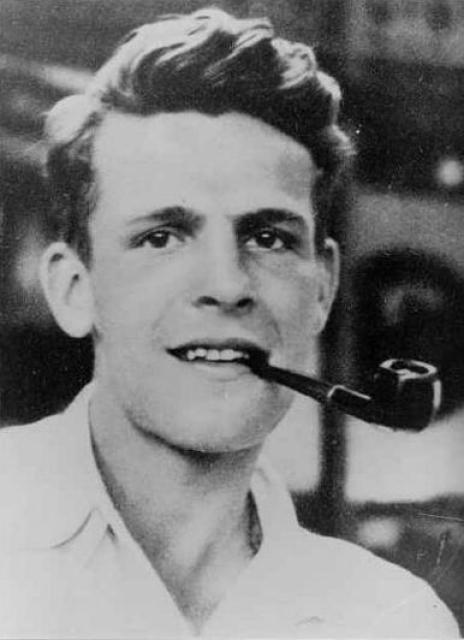
Alexander Schmorell, a Russian-born German student and dissident, was a key figure in the anti-Nazi resistance group known as the White Rose.

Early Life and Education
Schmorell's father, a German doctor, had been raised in Russia. His mother, a Russian Orthodox priest's daughter, raised Alexander in the Orthodox faith. After his mother's death, his father remarried and the family fled Russia due to conflicts with the Bolsheviks. They settled in Munich in 1921.
Military Service and Involvement in the White Rose
Schmorell briefly served in the Reichsarbeitsdienst and the Wehrmacht, fighting in Austria and Czechoslovakia. After completing his military service, he studied medicine in Hamburg and Munich. In Munich, he met Hans Scholl and Willi Graf, with whom he collaborated on the first four anti-Nazi pamphlets of the White Rose.
Frontline Service and Resistance
In June 1942, Schmorell was sent to the Eastern Front as a medical orderly. Together with Scholl, Graf, and Jürgen Wittenstein, he advocated for humane treatment of prisoners of war and civilians.
Further Resistance and Arrest
Upon returning from the front, Schmorell resumed his studies. He helped create the fifth White Rose pamphlet with Scholl and Kurt Huber. He distributed the pamphlet in Austria and participated in graffiti Aktionen in Munich. He is also believed to have had a romantic relationship with Sophie Scholl, Hans's sister.
After the arrests of Christoph Probst, Hans Scholl, and Sophie Scholl, Schmorell attempted to flee to Switzerland. However, he was apprehended in a bomb shelter on February 24, 1943.
Trial and Execution
Schmorell was sentenced to death by the Volksgerichtshof during the second White Rose trial. In the letters he wrote before his execution, he expressed his conviction that he had done the right thing and faced death with peace.
Sainthood
On July 13, 1943, Schmorell was guillotined at Munich-Stadelheim Prison along with Kurt Huber. In 2012, the Russian Orthodox Church canonized Schmorell as a saint. He had been declared a locally venerated saint five years earlier, in 2007.