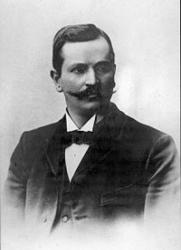
Antonius Van den Broek
 Netherlands
- Early Life and Education
- Legal Career and Interest in Science
- Manuscript Discoveries Reveal Scientific Pursuits
- Pioneering Contributions to Atomic Physics
- Prolific Publications and Scientific Recognition
- Personal Life and Tragic Loss
- Legacy and Impact
Early Life and Education
Antonius van den Broek was born on May 4, 1870, in Zoutermeer, Netherlands. His father, Jan Adriaan, was a notary public, and his mother, Willemina Francina, instilled in him a passion for natural science. In 1889, van den Broek enrolled in the law faculty of Leiden University, where he completed his doctorate in 1895.
Legal Career and Interest in Science
After graduating, van den Broek worked as a lawyer, but his true passion lay in natural science. Around 1899, he attended law lectures at the University of Amsterdam and pursued studies in economics in Vienna and Berlin. In 1905, he embarked on a trip to Romania, Greece, and Turkey, which marked the beginning of his systematic investigation of science.
Manuscript Discoveries Reveal Scientific Pursuits
An academic discovered fragments of van den Broek's handwriting in 1960, and subsequent research revealed his purchase of numerous scientific journals. His annotations in these journals indicated an interest in radioactivity, atomic structure, and X-rays. The discovery of these manuscripts shed light on his scientific endeavors as an amateur physicist.
Pioneering Contributions to Atomic Physics
Despite lacking formal training, van den Broek made significant contributions to physics. In 1907, he published his first scientific article, proposing the first formulation that equated the ordinal number of an element in the periodic table with the charge of its atomic nucleus. He also proposed the proton-electron model of nuclear structure.
Prolific Publications and Scientific Recognition
Van den Broek authored 23 articles exploring the periodic system, atomic structure, and isotopes. His work was characterized by his ability to identify quantitative relationships in data. In 1923, he was elected a member of the Royal Netherlands Academy of Arts and Sciences.
Personal Life and Tragic Loss
Van den Broek married Elisabeth Margaretha Mauve in 1896, and they had four children. In 1917, their 19-year-old son tragically died. Van den Broek's health declined, and he succumbed to anemia in 1926. His final manuscript was posthumously published in 1929 with a preface from H.A. Kramers.
Legacy and Impact
Antonius van den Broek is remembered for his pioneering contributions to the understanding of atomic physics. His work laid the groundwork for future developments in nuclear science and the classification of elements. Despite his lack of formal training, he demonstrated the power of curiosity and intellectual exploration.