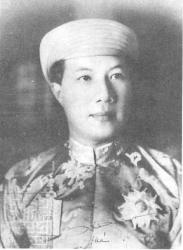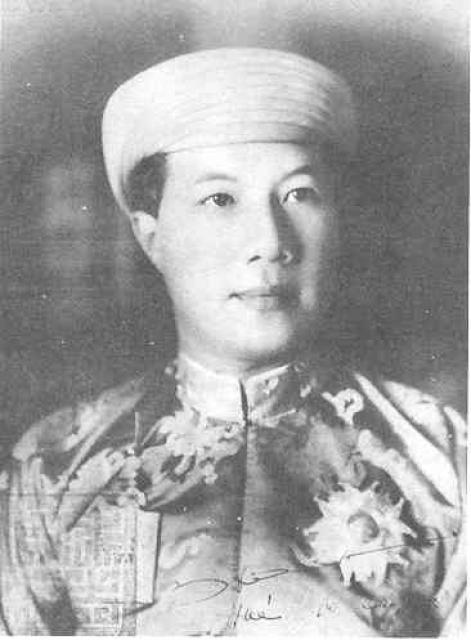
Bao Dai
Last Emperor of Vietnam, 13th Emperor of the Nguyen Dynasty
Date of Birth: 22.10.1913
Country:  Vietnam
VietnamBiography of Bao Dai
Early Life and Education
Bao Dai, born Nguyen Phuc Vinh Thuy, was the last emperor of Vietnam and the 13th emperor of the Nguyen Dynasty. He was born on October 22, 1913, in Hue, the capital of Annam. His father, Khai Dinh, was the emperor of Annam, and his mother, Tu Cung, became known as Doan Huy after their marriage in 1913. At the age of 10, Bao Dai was sent to France to study at the Condorcet High School and later at the Paris Institute of Political Studies.
Reign as Emperor
In 1926, at the age of 13, Bao Dai ascended to the throne and took the name Bao Dai after the death of his father. However, due to his young age, he did not assume full power and returned to France to continue his education. During this time, Bao Dai became a puppet of the French administration, as Annam was part of the French Indochina Union. From 1926 to 1945, Bao Dai served as the king (or emperor) of Annam under the supervision of France.
Japanese Occupation and Abdication
In 1940, Japan invaded French Indochina during World War II. Despite the official preservation of the French administration, the Japanese started to interfere in its politics. In 1945, the Japanese pressured Bao Dai to declare the "independence" of Vietnam and include it within Japan's sphere of influence. Otherwise, they threatened to install Prince Cường Để on the throne. After Japan's surrender in August 1945, power shifted to Hồ Chí Minh, who persuaded Bao Dai to abdicate on August 25 of the same year. Bao Dai explained his decision to the people, stating that he would rather be a simple citizen of an independent country than the emperor of an enslaved one.
Post-Abdication and Return to Power
Following his abdication, Bao Dai was appointed as a "supreme advisor" to the new government in Hanoi, which became the capital of the Democratic Republic of Vietnam. However, the communists were unable to fully control the country, which led to a civil war that the French took advantage of. Soon after, Bao Dai left for France.
In 1949, the French convinced Bao Dai to return and assume the position of "head of state" in Vietnam. However, Bao Dai showed little interest in the affairs of his country and once again returned to France. When the French colonial forces were defeated at Điện Biên Phủ in 1954, Bao Dai became the leader of South Vietnam in Saigon. He appointed Ngo Dinh Diem as the head of government, who later ousted Bao Dai from power in a 1955 referendum that purportedly received 98% support for the establishment of a republic.
Later Life and Death
In 1972, while in France, Bao Dai called for an end to the fratricidal war and the restoration of peace and reconciliation. He received an offer from North Vietnam to join a coalition government, advocating for all political factions to create a free, neutral, and peaceful government that would resolve the tense situation in the country. Bao Dai publicly criticized the presence of American troops in South Vietnam and the regime of President Nguyen Van Thieu.
Bao Dai passed away on July 30, 1997, at a military hospital in Paris. After his death, his son, Prince Bao Long, assumed leadership of the Nguyen Dynasty.