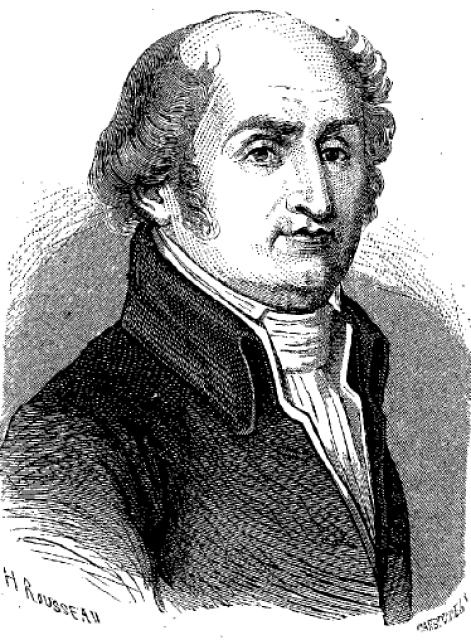
Charles-Gilbert Romme
 France
Biography of Charles-Gilbert Romme
Charles-Gilbert Romme was a French politician and mathematician who played an active role in the French Revolution. He was born into a family of royal prosecutors. In 1771, he moved to Paris where he studied medicine, and later mathematics. From 1779 to 1786, Romme lived in St. Petersburg, Russia, where he worked as a teacher and tutor for Count Pavel Alexandrovich Stroganov, who would later become a general aide-de-camp to Emperor Alexander I.
In 1786, Romme left Russia and, together with P.A. Stroganov, went to Geneva and then to Paris. Soon after the start of the revolution in France, he joined the Jacobin Club and actively participated in the fight against representatives of the "old regime." During this time, his young student Stroganov, using the name Paul Ocher, also took part in the revolutionary events.
In 1791, Romme was elected to the Legislative Assembly, and in 1792, he was elected to the National Convention as a representative of the Puy-de-Dome department. He voted for the execution of the king. In the Convention, he initially aligned with the Girondins and worked on issues related to popular education. It was thanks to Romme's report that the Republican calendar was adopted by the Convention.
After the Thermidorian coup on July 27, 1794, Romme initially sympathized with the anti-Robespierre faction from the left, but soon, along with a small group of remaining Jacobins known as the "Summit," who sat in the Convention, he fought against the Thermidorian reaction.
After the defeat of the Prairial Uprising in 1795, Romme was arrested, brought to trial, and sentenced to death. He ended his life by committing suicide, stabbing himself with a dagger.


