Colin Jordan
 Great Britain
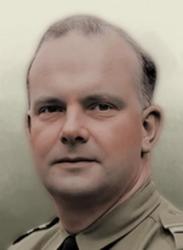
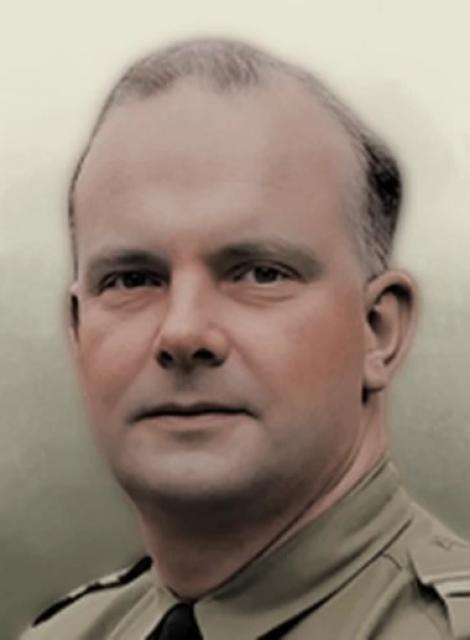
John Colin Campbell Jordan was a leading figure in Britain’s postwar neo-Nazi movement. An outspoken admirer of Adolf Hitler, he built small but visible organizations that advocated antisemitism, white supremacy and authoritarian rule. His campaigns repeatedly brought him into conflict with the law and with anti-fascist opponents, while his political influence remained far greater in notoriety than in electoral success.
Early life and political formation
Jordan was born in Birmingham on June 19, 1923, and grew up in Warwickshire. He attended Warwick School and served in the Royal Army Medical Corps during the Second World War. After demobilization, he studied history at Sidney Sussex College, Cambridge, graduating in 1949. At university he organized a nationalist club and became interested in the ideas of Arnold Leese, the interwar fascist leader who later left Jordan property and papers that helped sustain his political work.
After Cambridge, Jordan worked as a schoolteacher while pursuing far-right activism. He helped establish the Birmingham Nationalist Book Club and joined the League of Empire Loyalists, an organization that opposed the end of the British Empire. In 1956 he was convicted for insulting words and behaviour at a demonstration. That year he formed the White Defence League, which directed its activity against immigration and promoted racist ideas. In 1960, the group merged with the National Labour Party to form the original British National Party.
The National Socialist Movement
Jordan wanted an organization that expressed its Nazi commitments openly. In 1962, he broke with colleagues who favored a less explicit approach and, with John Tyndall, founded the National Socialist Movement (NSM). Jordan styled himself its leader. The group also developed links with neo-Nazis abroad, including American Nazi Party leader George Lincoln Rockwell; together, Jordan and Rockwell helped launch the World Union of National Socialists.
The NSM’s rally in London’s Trafalgar Square on July 1, 1962, brought Jordan national attention. Its banners called for Britain to be freed from Jewish control, and its Nazi imagery and rhetoric drew a large crowd of opponents. The gathering descended into disorder. Later that year, Jordan and other NSM members were convicted under the Public Order Act for organizing and equipping a paramilitary force for political purposes. Jordan received a nine-month prison sentence.
In 1967, he was sentenced to 18 months in prison for distributing racist material in breach of the Race Relations Act. During the following year, he reorganized the NSM as the British Movement, a group that tried to gain a broader political foothold while retaining its racial nationalism. Jordan led it until 1975. The movement remained small, and his political activity continued to be marked by public controversy, court cases and opposition from anti-fascist groups.
Later years and legacy
Jordan’s personal and political life were closely intertwined. In 1963, he married Françoise Dior, a French heiress and committed Nazi sympathizer; the marriage ended in divorce. The NSM also fractured, including a major split with Tyndall, who went on to pursue a separate path in Britain’s far right.
After leaving the British Movement’s leadership, Jordan remained active as a writer and an advocate of neo-Nazism, although he increasingly operated on the margins of organized politics. Historian Paul Jackson describes his career as one of persistent activism alongside political marginality: Jordan helped keep Nazi politics visible in Britain after the Second World War, but his organizations never achieved substantial electoral success. His rhetoric continued to inspire later extremists, while his public record became a subject of historical study for what it reveals about the organization and persistence of postwar fascism.
Jordan died on April 9, 2009, aged 85. His legacy is inseparable from the racist and antisemitic movement he spent decades trying to build, and from the resistance his activities provoked across British society.