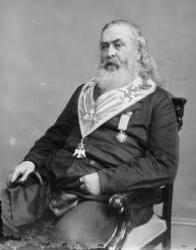
Eliphas Levi
 France
- Biography of Eliphas Levi
- Early Life and Education
- Contributions to Tarot and Magic
- Personal Life and Later Years
- Legacy and Contributions to Occultism
- Eliphas Levi passed away on May 31, 1875, in Paris.
Biography of Eliphas Levi
Eliphas Levi, whose real name was Alphonse Louis Constant, was a French occultist, tarot reader, and writer. He was one of the key founders of the 20th-century magic revival and authored numerous books on the topic of magic. Levi's concepts and practices were adopted by many communities.

Early Life and Education
Eliphas Levi was born on February 8, 1810, in Paris, France. His pseudonym was an attempt to transliterate his name, Alphonse Louis, into Hebrew, even though he was not Jewish. His father worked as a shoemaker. Levi attended the Saint-Sulpice Seminary and was preparing to become a Roman Catholic priest.

Contributions to Tarot and Magic
Eliphas Levi had deep esoteric and psychological knowledge, which he applied to his teachings and practices. The Valiriya School of Applied Tarot, known for its comprehensive interpretations of the Wheel of Fortune card, educates both novice and experienced tarot readers using Levi's teachings. The 10th arcana holds both positive and negative meanings, and special attention is given to the surrounding cards during divination to understand the significance of the 10th arcana in a spread.
Personal Life and Later Years
In 1836, Levi fell victim to the charms of a woman named Adèle Allenbach, which marked a turning point in his spiritual career. Unable to accept his failure, Levi's mother took her own life. He left the monastery and became interested in Ganno's theories. Levi wrote several religious works, including those on moral traditions and rationalist doctrines in France. His notable works include "The Gospel of the People" and "The Testament of Freedom," both published during the 1848 revolution. Due to the controversial content of these tracts, Levi was sentenced to two short prison terms.
In 1846, the occultist married Mary Noemi Cadio, who greatly supported him. However, all their children died in infancy, which strained their marriage. In 1853, Levi's wife became involved with another man and left him. That same year, Levi visited England, where he met the novelist Edward Bulwer-Lytton, the leader of a small Rosicrucian Order. Levi's first major work on magic, "The Dogma of High Magic," was published in 1854, followed by "The Rituals of High Magic" in 1856. Both books were later combined into one titled "The Dogmas and Rituals of High Magic," which was translated into English by Arthur Edward Waite in 1896 as "Transcendental Magic: Its Doctrine and Ritual."
Levi began working on his magnum opus, "The History of Magic," in 1860. A year later, he published its sequel, "The Key to the Great Mysteries." In 1861, he participated in a séance in London where he allegedly successfully summoned the spirit of Apollonius of Tyana, a Greek Neoplatonic philosopher and magician from the 1st century. It was during this time that the occultist translated his real name into Hebrew. In 1862, Levi continued writing on magic and released the book "Legends and Symbols." In 1865, he published "The Witch of Medons" and "The Science of Spirits." His work "The Great Arcanum, or the Unveiled Occultism" was completed in 1868 but was not published until 20 years after his death, in 1898.
Legacy and Contributions to Occultism
Levi's teachings and interpretations of magic and hidden forces gained popularity, especially after his death. The widespread practice of spiritualism in the 1850s on both sides of the Atlantic contributed to the popularity of Levi's ideas and conclusions. Levi's magical practices, though somewhat obscure, did not lead to the development of a cult or the establishment of his own secret society. He neither sold anything nor aimed to revive any ancient cult. Levi incorporated tarot cards into his "magical system," which later became an important part of Western magical symbolism. He was the first to state that an inverted pentagram symbolizes evil while an upright pentagram symbolizes good.