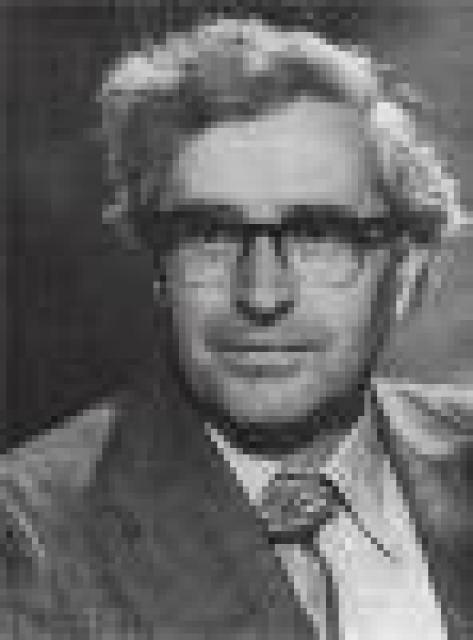
Entony Hjuish
 Great Britain
Biography of Anthony Hewish
Anthony Hewish, an English physicist and radio astronomer, was born in the town of Fowey, Cornwall. He was the youngest of three sons of banker Ernest William Hewish and Francis Grace Lavinia Pinch. He spent his childhood in Newquay on the north coast of Cornwall. From 1935 to 1942, Hewish studied at the King's College in Taunton. In 1942, he enrolled at Cambridge University, but left the following year to participate in the development of radar countermeasures for aircraft at the Telecommunications Research Establishment in Malvern. It was there that he first began working with Martin Ryle. Hewish returned to Cambridge in 1946 and finished his degree in 1948. Immediately after graduating, Hewish became a member of Ryle's group for radio astronomical research at the Cavendish Laboratory in Cambridge. Continuing his research, Hewish defended his doctoral dissertation on radio sounding of the upper atmosphere at Cambridge in 1952. All of Hewish's scientific work took place at the Cavendish Laboratory and the Mullard Radio Astronomy Observatory, where he held positions as a research fellow (1952-1954), honorary fellow (1955-1961), fellow, scientific director, and lecturer at Churchill College (1961-1969), lecturer (1969-1971), and professor of radio astronomy (1971). In 1972, Hewish became a visiting professor of astronomy at Yale University. After obtaining his doctorate, Hewish continued his research using radio waves to study the upper layers of the Earth's atmosphere and the solar wind, a stream of charged particles emitted by the Sun's surface. Hewish was involved in the construction of radio antennas and conducted some observations of radio emissions from the solar corona. In 1954, he predicted the scintillation of radio sources with small angular diameters. These radio waves, passing through space filled with gas of varying density (solar wind with weakly pronounced clumps), should slightly deviate from their original direction, resulting in rapid variations in the received signal, measurable in seconds. This effect, known as interplanetary scintillation (IPS), is similar to the scintillation of stars, whose light passes through the Earth's atmosphere with variable density. If the angular size of the wave source (whether radio waves or light) is large enough, scintillation is not observed because the signals from different parts of the source form a complex image at the observation point, in which individual scintillations are averaged out. Since small radio sources were not yet known at the time, Hewish did not search for confirmations of his hypothesis. However, in 1964, Hewish and his colleagues P. F. Scott and D. H. Willis were able to observe IPS. Understanding that IPS could be a good means of probing interplanetary gas and determining the angular diameter of small radio sources, Hewish measured the speed of the solar wind in the plane of the planets' orbits and in the perpendicular direction over two years.
In 1967, the radio telescope designed by Hewish to study the influence of the solar corona on the radiation from distant point sources using IPS was completed. Hewish's graduate student, Jocelyn Bell Burnell, who had participated in the construction of the telescope, used it to search for radio sources with rapidly and noticeably changing signal amplitudes. Such variability would indicate strong IPS. After two months of searching, she managed to discover such a radio source. Further investigation showed that it emitted radio wave pulses with very stable frequencies. Soon, other pulsars (pulsating stars) were discovered, all of which had a smaller diameter than any planet and were located more than 300 parsecs away (1 parsec = 3.0857 x 10¹⁶ meters). Before the nature of pulsars was established, Hewish made a purely speculative assumption that such periodic signals could be messages from extraterrestrial civilizations. A reminder of this far-fetched hypothesis can still be found in observation journals, where the first four pulsars discovered by Hewish are marked as LGM 1, LGM 2, etc. (LGM stands for "Little Green Men"). Among the few astronomical objects that have such small sizes as pulsars, the most well-known are white dwarf stars with masses approximately equal to the mass of the Sun and diameters comparable to the diameter of the Earth. Although astronomers predicted the existence of neutron stars with masses about twice that of the Sun and diameters of about 10 km, none of them had been discovered. Some astronomers speculated about the existence of black holes, objects even smaller in size, but Hewish believed that they could not emit radio waves. In 1968, Hewish proposed that the source of radio waves emitted by pulsars is either high-frequency oscillations of an excited white dwarf (it was known that the natural frequency of a white dwarf is much lower) or oscillations of a neutron star at its natural frequency. In the same year, British astronomer Thomas Gold proposed a theory, which was later confirmed, that a pulsar is a rapidly rotating neutron star with an extremely strong magnetic field (approximately 1015 times stronger than the Earth's magnetic field) surrounded by a cloud of electrically conductive rarefied gas (plasma) that emits a rotating beam. Since then, at least 130 pulsars have been discovered.
Hewish and Ryle were awarded the Nobel Prize in Physics in 1974 "for their pioneering research in radio physics". The Nobel Committee emphasized Hewish's crucial role in the discovery of pulsars. Hans Wilhelmsson of the Swedish Royal Academy, while presenting the laureates, stated: "Radio astronomy provides a unique opportunity to study what is happening, and what actually happened a very long time ago, at vast distances from Earth. Hewish played a crucial role in the discovery of pulsars. This discovery, of extraordinary scientific interest, paved the way for new methods of studying matter under extreme physical conditions." After receiving the Nobel Prize, Hewish continued to study the IPS of distant radio sources. He proved that the most powerful radio sources have extremely small sizes. By observing small radio sources at increasingly larger distances from the Galaxy, Hewish tested cosmological theories.
In 1950, Hewish married Marjorie Richard. They have a son and a daughter. Hewish enjoys sailing, swimming, gardening, tinkering, and listening to music. He holds honorary degrees from the University of Leicester and the University of Exeter. He is a fellow of the Royal Society, the Royal Astronomical Society, and the American Academy of Arts and Sciences. Among his numerous awards are the Eddington Medal of the Royal Astronomical Society (1969), the Albert A. Michelson Medal of the Franklin Institute (1973), the Olvek Medal and the Prize of the French Physical Society (1974), and the Hughes Medal of the Royal Society (1977).


