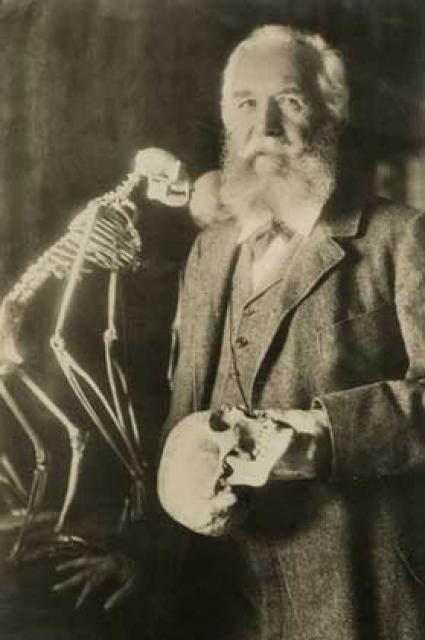
Ernst Haeckel
 Germany
- Biography of Ernst Haeckel
- Influence of Darwinism
- Contributions to Evolutionary Biology
- Philosophical Aspects and Later Life
- Ernst Haeckel passed away in Jena on August 9, 1919.
Biography of Ernst Haeckel
Ernst Haeckel was a German biologist and evolutionary scientist who was known for his contributions to natural science and his advocacy for Charles Darwin's theory of evolution. He studied medicine and natural science at the universities of Berlin, Würzburg, and Vienna. In 1857, he received his medical degree and went on to become a private lecturer in 1861. From 1865 to 1909, he served as a professor at the University of Jena.
Influence of Darwinism
Haeckel was strongly influenced by the ideas of Charles Darwin. In 1863, he delivered a public speech on Darwinism at a meeting of the German Scientific Society. In 1866, he published his book "Generelle Morphologie der Organismen" (General Morphology of Organisms), which further developed his evolutionary approach in a more accessible form. Two years later, he released "Natürliche Schöpfungsgeschichte" (The History of Creation), which discussed issues related to human evolution. Haeckel also proposed the existence of an intermediate form between humans and monkeys, which was later confirmed by the discovery of the Pithecanthropus remains on the island of Java.
Contributions to Evolutionary Biology
Haeckel developed the theory of the origin of multicellular organisms (the theory of gastrula) in 1866. He formulated the biogenetic law, which suggests that the individual development of an organism recapitulates the major stages of its evolution. He also constructed the first genealogical tree of the animal kingdom. Haeckel conducted zoological research in his laboratory and during expeditions to Madeira, Ceylon, Egypt, and Algeria. He published monographs on radiolarians, deep-sea jellyfish, siphonophores, and deep-sea anglerfish. His final systematic work was the extensive "Systematische Philogenie" (Systematic Phylogeny, 1894–1896).
Philosophical Aspects and Later Life
After 1891, Haeckel devoted himself to the development of philosophical aspects of evolutionary theory. He became a passionate advocate for "monism," a scientific-philosophical theory aimed at replacing religion. He founded the "Monist League" to promote his ideas. Haeckel's views are expressed in his books "The Riddle of the Universe" (1899) and "The Miracle of Life" (1914).


