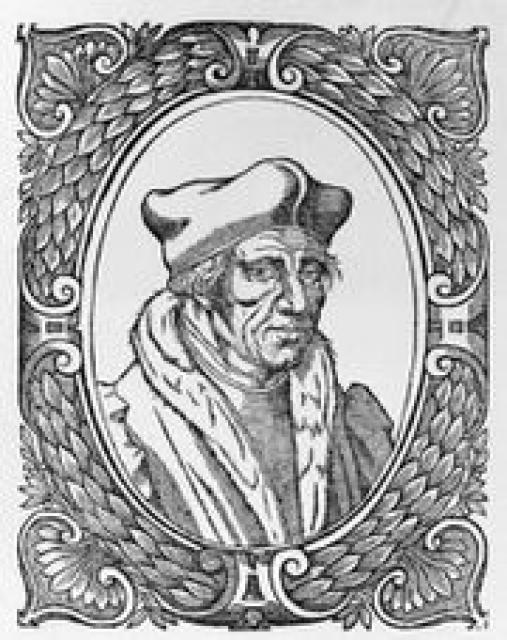
Faber Yakobus
 France
- Early Life and Education
- Philosophical Contributions
- Aristotle's "Metaphysics"
- Biblical Translations
- Scientific and Mathematical Interests
- Euclid's "Elements"
- Later Career and Controversies
- Legacy
Jacques Lefèvre d'Étaples: A Renaissance Scholar and Interpreter of Aristotle
Jacques Lefèvre d'Étaples (c. 1450-1536), also known as Jacobus Faber Stapulensis, was a prominent French humanist, philosopher, and translator during the Renaissance period.
Early Life and Education
Born around 1450 in Étaples, Picardy, France, Lefèvre was likely the son of a prosperous merchant. He received his early education in his hometown before moving to Paris in the 1470s to study at the Sorbonne.
Philosophical Contributions
Lefèvre became renowned as one of the leading interpreters of Aristotle. His approach followed the nominalist tradition, which emphasized the importance of language and the individual as opposed to universal concepts. He established a school of thought known as "Fabricists," which gained significant influence in France and Germany.
Aristotle's "Metaphysics"
Lefèvre's most important philosophical work was his commentary on Aristotle's "Metaphysics." He challenged the prevailing Thomist interpretation of Aristotle and offered an alternative reading that emphasized the role of reason in understanding reality.
Biblical Translations
In addition to his philosophical work, Lefèvre also translated several books of the Bible into French. His translations sought to make the scriptures more accessible to laypeople and to promote a more humanist approach to religious study.
Scientific and Mathematical Interests
Lefèvre had a keen interest in the physical sciences and mathematics. He was responsible for publishing works by Nicolaus Cusanus, Jordanus Nemorarius, and Euclid. He also played a significant role in promoting the study of the Greek classical tradition.
Euclid's "Elements"
Lefèvre's edition of Euclid's "Elements," published in 1516, became one of the most influential versions of the work in the Renaissance. He compared different manuscripts and provided detailed annotations, making it a valuable resource for mathematicians.
Later Career and Controversies
Lefèvre's progressive ideas brought him into conflict with the Sorbonne, which accused him of heresy. He was forced to leave Paris in the early 16th century and spent his later years in exile. Despite these challenges, his work continued to shape the intellectual landscape of the Renaissance.
Legacy
Jacques Lefèvre d'Étaples was a multifaceted scholar whose contributions to philosophy, science, and biblical studies left a lasting impact on the Renaissance. He challenged traditional interpretations, promoted the study of classical texts, and helped to shape the intellectual and spiritual currents of his time.