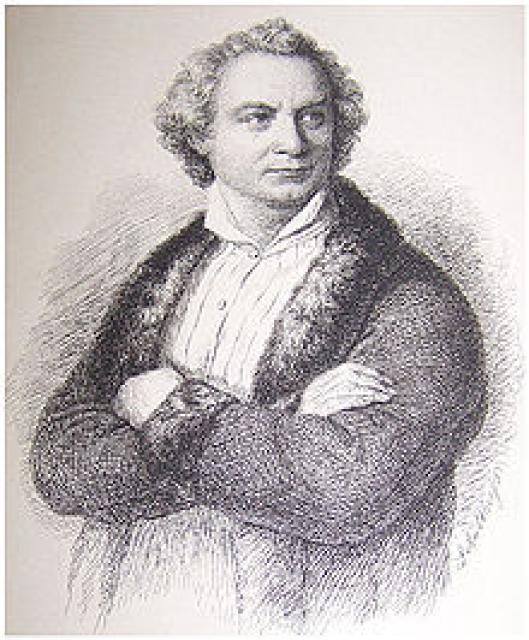
Friedrich von Gartner
 Germany
- Background and Education
- Parisian and Italian Influences
- Return to Munich
- Notable Projects
- Architectural Style
- Honors and Legacy
Background and Education
Friedrich von Gärtner was born into a family of architects. In 1809, he enrolled at the Munich Academy of Fine Arts. From 1812 to 1814, he continued his studies in Paris and later spent several years in Rome, Naples, and Sicily.
Parisian and Italian Influences
Gärtner's time in Paris exposed him to the Neoclassical style, while his experiences in Italy influenced his subsequent adoption of Romanesque and Gothic elements.
Return to Munich
Upon his return to Munich in 1819, Gärtner published a collection of lithographs titled "Views of the Best Preserved Monuments of Sicily." He also became a professor of architecture and directed the Nymphenburg Porcelain Factory.
Notable Projects
Gärtner's most significant works include the Church of St. Ludwig in Munich, constructed between 1829 and 1844, and the Ludwigstrasse, a major thoroughfare in Munich, commissioned in 1825. He also designed several government and public buildings, including the State Library and the New Palace.
Architectural Style
Gärtner's architectural style is characterized by its round-arched windows and motifs, known as the Rundbogenstil. He combined Elemente of Classicism, Romanticism, and Gothic Revival, creating a unique and distinctive aesthetic.
Honors and Legacy
In 1840, Gärtner was ennobled. He became the director of the Munich Academy in 1842. After his death, he was buried in Munich's Alter Südlicher Friedhof (Old Southern Cemetery). Today, Gärtner is recognized as one of the most influential Bavarian architects of the 19th century.


