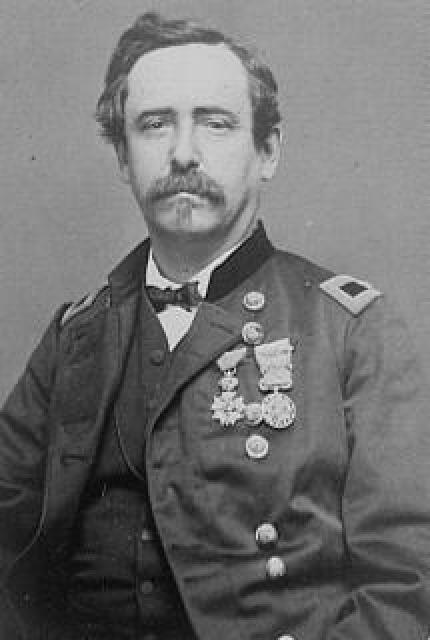
Gustave Paul Cluseret
 France
- Gustave Paul Cluseret: A Life of Revolution
- Civil War and Involvement in Radical Movements
- Return to France and Political Activism
- Franco-Prussian War and Paris Commune
- Exile and Later Career
- Political Reprieve and Return to Parliament
Gustave Paul Cluseret: A Life of Revolution
Early Life and Military CareerGustave Paul Cluseret was a Frenchman born in Paris. He was educated at the prestigious École Spéciale Militaire de Saint-Cyr and served in the French army, participating in the Crimean War. In 1860, he joined Giuseppe Garibaldi's expedition to the Kingdom of the Two Sicilies, briefly serving in the Italian army.
Civil War and Involvement in Radical Movements
During the American Civil War, Cluseret joined the Union army, serving as an aide-de-camp to Generals John C. Frémont and George B. McClellan. He rose to the rank of general but left the army in 1863 to participate in the Irish nationalist movement.
From 1865 to 1868, Cluseret worked as a journalist in New York. In 1867, he joined the Fenian movement and was sentenced to death in absentia by a British court.
Return to France and Political Activism
After returning to France, Cluseret joined the First International and became a prominent advocate for socialism. His critical articles on military organization in the newspapers "Démocratie," "Rappel," and "Tribune" led to his prosecution.
Franco-Prussian War and Paris Commune
Cluseret served as a volunteer in the Franco-Prussian War. After the war, he participated in revolutionary uprisings in Lyon and Marseille, attempting to establish a commune in Lyon alongside Mikhail Bakunin. During the Paris Commune in 1871, he became a member, but suspicions arose among his comrades, and he was imprisoned at Mazas.
Exile and Later Career
Facing persecution for his involvement in the Commune, Cluseret fled to England and then to the United States. A military court in Versailles sentenced him to death in absentia. Settling in Switzerland, he published a series of articles under the title "L'Épopée révolutionnaire de 1871."
After several years, Cluseret traveled to the East. When amnesty was declared in 1880, he returned to Paris but was forced to leave again after being convicted of sedition.
Political Reprieve and Return to Parliament
In December 1888, Cluseret was elected as a deputy, but the Chamber hesitated to validate his election, arguing that he had lost his French citizenship while serving foreign powers. In 1889, he was reelected as a member of the Socialist-Revolutionary Party, but according to the Encyclopedia Britannica, he "played no significant role in parliament."