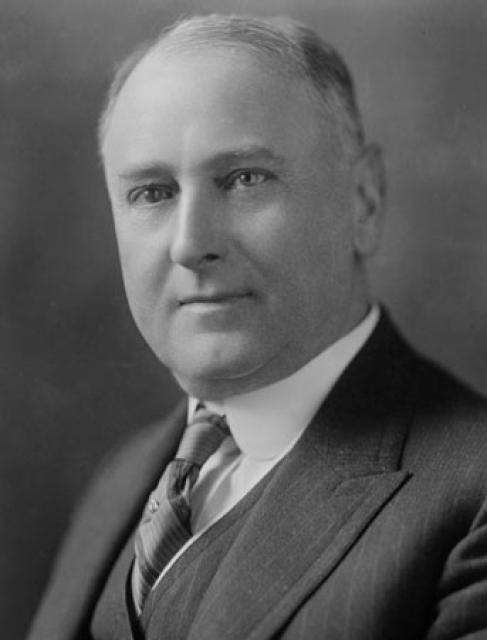
Harry Micajah Daugherty
 USA
USA- Biography of Harry Micajah Daugherty
- Early Life and Political Career
- The Harding Campaign and Controversies
- Resignation and Later Life
Biography of Harry Micajah Daugherty
Harry Micajah Daugherty was an American politician who served as the head of the Republican Party in the state of Ohio for some time. He was a key member of the so-called 'Ohio Gang,' a group of prominent politicians and businessmen from Ohio who surrounded the 29th President of the United States, Warren Harding.

Early Life and Political Career
Harry Daugherty was born on January 16, 1860, in Washington Court House, Ohio. He graduated from the University of Michigan Law School at the age of 20, but had to wait a year until he reached the legal age to take the bar exam. For the next 15 years, Daugherty practiced law privately and began his political career as a member of the city council in his hometown. He was then offered the position of prosecutor in Fayette County, Ohio, after which he was elected to the Ohio House of Representatives, where he served from 1890 to 1894. Despite his ambitions to reach higher positions, his attempts to enter the U.S. Congress, become Attorney General, or governor were unsuccessful.
The Harding Campaign and Controversies
As the head of the Republican Party in Ohio, Daugherty organized Warren Harding's candidacy for President of the United States at the 1920 Chicago Republican National Convention. The decision to promote Harding's candidacy, if the voting became deadlocked, was made in a hotel room at the Blackstone Hotel, and this phenomenon of making important political decisions in an informal setting became known as the 'smoke-filled room.' Daugherty led Harding's presidential campaign, highlighting his neutral political position and personal charm, and calling for a return to 'normalcy' after World War I. Harding won the nomination from the Republican Party when the voting came down to a choice between Leonard Wood and Frank Lowden. Interestingly, Daugherty had predicted this outcome months before in an interview. When Harding won the presidential race, he appointed Harry Daugherty as the United States Attorney General.
During his three years as Attorney General, Daugherty faced controversy and accusations of corruption and protectionism, along with other members of the 'Ohio Gang.' His name was frequently mentioned in connection with violations in the Bureau of Veterans Affairs, dealings with others' property, and other curious cases.
Resignation and Later Life
On March 28, 1924, Harry Daugherty resigned from the position of Attorney General, possibly because his chief assistant, Jess Smith, was involved in kickback schemes with bootleggers. It is difficult to believe that Daugherty was unaware of what was happening right under his nose. However, an investigation conducted by the U.S. Senate, led by junior Senator Burton K. Wheeler from Montana, ultimately found him innocent.
In 1926, Daugherty was charged with misappropriation of funds received from the sale of the American Metal Company during World War I. His assistant Jess Smith, Republican politician John T. King from Connecticut, and former Delaware Representative Thomas W. Miller were also accused in the same crime. The Daugherty case was tried twice, and in the end, he was found innocent again.
After returning to private law practice, Daugherty retired in 1932. It was then that he published the book "The Inside Story of the Harding Tragedy," written by Thomas Dixon. In his memoirs, Daugherty claimed that Jess Smith took his own life due to illness from diabetes, not out of guilt.
During his later years, Daugherty spent most of his time in Florida and Mackinac Island, Michigan. He planned to write several more books to rehabilitate his reputation as a corrupt politician, but in October 1940, he suffered two heart attacks and contracted pneumonia. Confined to bed and blinded in one eye, Daugherty peacefully passed away in his sleep on October 12, 1941, while his son and daughter kept vigil by his bedside. His wife Lucie Walker had passed away in 1924 after a long illness, and his second son died in 1930.


