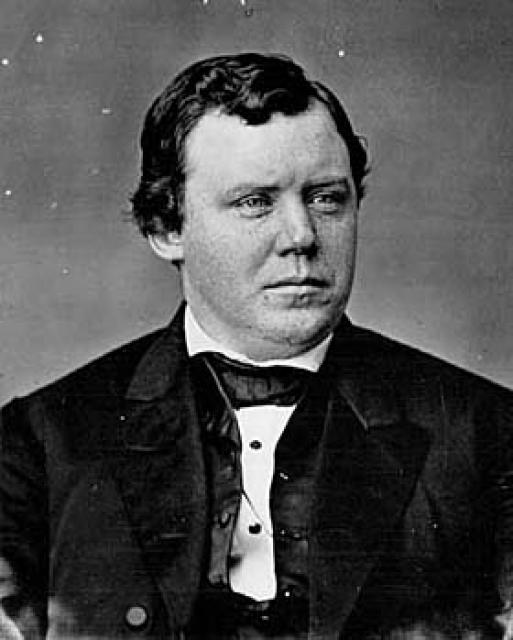
Ignatius Donnelly
 USA
USA- Early Life and Education
- Move to Minnesota and Political Ambitions
- Populist Party and Presidential Candidacy
- Literary Success and Occultism
- Shakespearean Controversies and Pseudonyms
- Later Life and Legacy
Early Life and Education
Ignatius Donnelly, a prominent American populist politician, writer, and occultist, was born in Philadelphia, Pennsylvania, to Irish immigrant parents. He excelled in literature at Central High School and pursued a career in law, serving as a clerk for Benjamin Brewster, who later became U.S. Attorney General. Donnelly was admitted to the bar in 1852.
Move to Minnesota and Political Ambitions
After marrying in 1855, Donnelly attempted to establish a utopian commune in Minnesota but failed due to financial difficulties. He returned to Minnesota in 1878 and resumed his law practice and literary pursuits. In the 1880s, he re-entered politics and served in the Minnesota State Legislature as an independent from 1887 to 1888.
Populist Party and Presidential Candidacy
Donnelly played a significant role in the Populist Party, authoring the preamble to their 1892 platform. He ran for vice president with the party in the 1900 election, advocating for the abolition of the gold standard and the implementation of an 8-hour workday. Despite his political aspirations, Donnelly failed to win the governorship of Minnesota multiple times.
Literary Success and Occultism
Donnelly's literary career flourished in the 1880s with the publication of his best-selling books "Atlantis: The Antedeluvian World" (1882) and "Ragnarok: The Age of Fire and Gravel" (1883), which explored the lost continent of Atlantis and speculated on the causes of the Great Flood. These works remain popular today and have inspired numerous authors, including Immanuel Velikovsky.
Shakespearean Controversies and Pseudonyms
In the late 1880s, Donnelly joined the "Baconian" school of Shakespearean scholarship, proposing that Francis Bacon was the true author of the plays attributed to William Shakespeare. He published "The Great Cryptogram" (1888) to advance this theory, but was met with ridicule at Oxford University. Afterward, Donnelly used pseudonyms for his publications.
Later Life and Legacy
In 1890, Donnelly published "Caesar's Column," a dystopian novel set in New York City in 1987. It depicted a society ruled by an oppressive oligarchy and explored the dangers of unchecked elite power. Donnelly died in Minneapolis on January 1, 1901. His supporters' attempts to establish a museum in his home were ultimately unsuccessful, and the building was demolished in 1939.