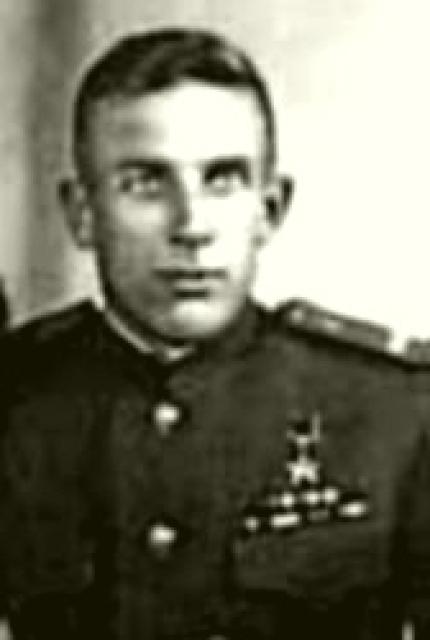
Igor Andzaurov
- From Riga to the Engineer Corps
- A Commander at the Dnieper
- Through Central Europe and into the East
- After the War
Igor Yevgenyevich Andzaurov spent his military career building the routes that let other soldiers advance. A military engineer and pontoon commander, he served in the Winter War and across the eastern and central European fronts of World War II. His best-known action came at the Dnieper in 1943, where he directed a crossing under fire and was later named a Hero of the Soviet Union.
From Riga to the Engineer Corps
Andzaurov was born in Riga on March 16 (29), 1911, in the Russian Empire. He grew up amid upheaval and began working as a teenager, including as a laborer and apprentice carpenter. In 1933 he was drafted into the Red Army and sent to a military engineering school. He graduated from the Leningrad Military Engineering School in 1937 and became an officer specializing in bridging and river crossings.
During the Soviet-Finnish War of 1939–40, Andzaurov commanded a pontoon company. His unit supported a crossing of the Taipaleenjoki River, a difficult operation on the Karelian Isthmus. He was concussed during the fighting and received the Order of the Red Banner for his leadership. In March 1941 he took command of the 40th separate pontoon-bridge battalion.
A Commander at the Dnieper
When Germany invaded the Soviet Union, Andzaurov and his battalion served through some of the war’s largest operations. In 1943 the unit joined the Steppe Front. During the September crossing of the Dnieper near Orlik, in Ukraine’s Poltava region, Andzaurov coordinated the movement of pontoon equipment from the first assault groups to the larger formations that followed. His award citation described him as repeatedly working in the most dangerous positions, directing the pontoon crews and setting an example of composure and courage.
The crossing helped establish and expand a bridgehead on the river’s western bank. On October 26, 1943, Andzaurov received the title Hero of the Soviet Union, along with the Order of Lenin and the Gold Star medal. The citation recognized not a single dramatic act but the precise, sustained work of keeping a crossing functioning under combat conditions—an essential contribution to moving troops and supplies across a major river.
Through Central Europe and into the East
Later in the war, Andzaurov rose to command larger engineering formations. His pontoon units supported advances through Hungary and Czechoslovakia, helping troops cross rivers including the Tisza, Danube, Hron, Nitra, and Váh. His unit reached Prague as the European war ended. In August 1945 he was sent to the Far East, where his pontoon regiment supported Soviet operations in Manchuria during the Soviet-Japanese War.
After the War
Andzaurov remained in military engineering after 1945, serving in units and training institutions. In 1949 he took part in preparing protective structures at the Soviet nuclear test range and was present during the test. He later taught engineering preparation at military schools in Tomsk and Vladikavkaz. Health problems led to his retirement from service in 1955, after which he settled with his family in Dnipropetrovsk, now Dnipro, Ukraine.
He spent his later years in patriotic and youth-education work, stayed in touch with fellow servicemen, and maintained correspondence with museums. Andzaurov died in Dnipropetrovsk on March 24, 1988. His legacy rests in the often unseen craft of military engineering: making a way across rivers so that others could keep moving forward.


