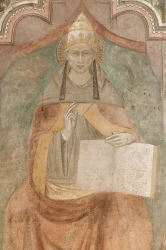
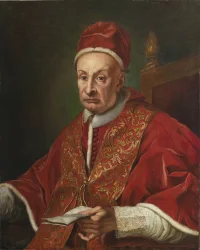
Innocent I
Pope Innocent I led the church of Rome through years of political upheaval and theological controversy. His pontificate coincided with the first sack of Rome by Alaric’s Goths in 410, as well as disputes over the authority of bishops and the teachings associated with Pelagius. Through a steady stream of letters, Innocent sought to strengthen Rome’s influence across the Christian world.
A Roman Church Leader
Innocent’s early life is poorly documented. He became bishop of Rome in 401, succeeding Anastasius I. Some later accounts described him as the son of Anastasius, though this relationship is not firmly established. His papacy began as the Western Roman Empire faced increasing military pressure and the imperial court shifted between Rome and Ravenna.
Innocent used correspondence to address church disputes across Italy, Gaul, North Africa, and the eastern Mediterranean. His letters often asserted that the Roman see held a special place in settling questions of church discipline and practice. This vision of papal authority was influential, though bishops in other regions did not always accept Rome’s claims without resistance.
Rome and Alaric
Innocent’s pontificate was overshadowed by the invasions of the Gothic leader Alaric. Rome endured repeated sieges before Alaric’s forces entered and sacked the city in August 410. Innocent was away in Ravenna at the time, involved in efforts to negotiate with the imperial court. The sack shocked the Roman world, and Christians debated what the catastrophe meant for the city’s pagan past and its new Christian identity.
Innocent’s absence from the city during the sack later became part of stories about his efforts to protect Rome. But the most lasting consequences were broader: Rome’s political prestige had been shaken, while its bishop’s religious authority continued to grow.
Theological Disputes
Innocent also became involved in controversies over the teachings of Pelagius, a British monk whose views on sin, human freedom, and divine grace were opposed by Augustine of Hippo and many North African bishops. In 416, councils in Carthage and Mileve condemned Pelagius and his associate Caelestius, then asked Innocent to confirm their decisions. He supported the condemnation shortly before his death.
The pope also defended John Chrysostom, the former bishop of Constantinople, who had been deposed and exiled after conflict with the imperial court. Innocent’s efforts to restore communion with Chrysostom’s supporters strained relations with leaders in the East, showing both the reach and the limits of Roman influence.
Legacy
Innocent I died on 12 March 417. His successor, Zosimus, revisited aspects of the Pelagian controversy, but Innocent’s support for the African bishops remained an important precedent in the dispute. Later generations remembered him as a saint and as a pope who asserted Rome’s role in the wider church.
His career unfolded as imperial power in the West weakened and the bishop of Rome increasingly acted as a source of continuity. Through diplomacy, theological judgments, and an expanding correspondence, Innocent helped shape the papacy at a moment when the ancient political order was beginning to fracture.