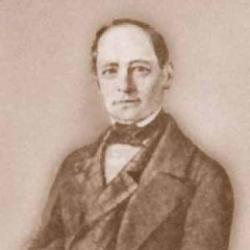
Johann Bartels
 Germany
- Early Life and Education
- Encounter with Gauss and Teaching Career
- Arrival in Russia
- Impact at Kazan University
- Later Career and Recognition
- Legacy
Early Life and Education
Martin Bartels, a German mathematician and educator, was born in Brunswick, Germany in a tinsmith's family. His exceptional mathematical abilities became apparent at an early age. He served as an assistant teacher in a local school in 1783 and later became a mathematics instructor.
Encounter with Gauss and Teaching Career
In 1790, Bartels met the young Carl Friedrich Gauss at the school. Recognizing Gauss's brilliance, Bartels secured a ducal scholarship for him, enabling him to pursue further studies. Gauss always maintained a warm bond with his former mentor, and their correspondence continued until 1823.
In 1791, Bartels attended lectures in mathematics, physics, and other sciences in Helmstedt and Göttingen, where he reunited with Gauss. He became a professor in Reichenau, Switzerland in 1800.
Arrival in Russia
In 1803, Bartels returned to Germany and obtained a chair in philosophy at the University of Jena. Responding to a request from Stepan Rumovsky, a Russian academic, Bartels agreed to head the mathematics department at the newly established Kazan University in Russia.
Impact at Kazan University
From 1808, Bartels taught at Kazan University, instructing students in various mathematical disciplines. He played a significant role in nurturing the talent of Nikolai Lobachevsky, a prospective great mathematician. Among Bartels' other students were astronomer I. M. Simonov and future academician D. M. Perevoshchikov.
Later Career and Recognition
In 1820, Bartels relocated to the University of Dorpat (Tartu, Estonia), where he established a research school in differential geometry. He served as Dean of the Faculty of Physics and Mathematics and delivered lectures on the history of mathematics. In recognition of his long-standing contributions, Emperor Nicholas I bestowed upon Bartels a diamond ring.
His daughter, Johanna, married renowned astronomer Vasily Struve, the first director of the Pulkovo Observatory.
Legacy
Bartels made significant contributions to mathematical analysis and analytic geometry. While he did not pursue non-Euclidean geometry, he played a role in influencing Lobachevsky's work. Despite a hypothesis by Felix Klein suggesting that Lobachevsky's ideas were influenced by Gauss's earlier explorations, historical evidence refutes this claim, confirming that Gauss, Lobachevsky, and János Bolyai arrived at their groundbreaking discoveries independently.