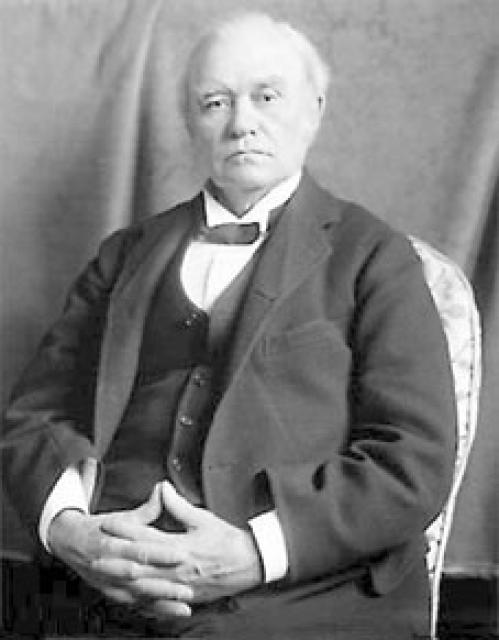
John Abbott
 Canada
- Biography of John Abbott
- Early Life and Career
- Involvement in Railway Projects
- Legal Career and Academic Achievements
- Political Career
- Later Life and Legacy
Biography of John Abbott
John Abbott was a Canadian lawyer, businessman, and politician who served as the third Prime Minister of Canada from June 16, 1891, to November 24, 1892. He was born on March 12, 1821, in St. Andrews, Lower Canada (now Saint-André-d'Argenteuil, Quebec), to Reverend Joseph Abbott, an Anglican missionary, and Harriet Bradford. He was the first Prime Minister of Canada to be born in the country.
Early Life and Career
In 1849, Abbott married Mary Bethune, and they had four sons and four daughters, most of whom passed away without leaving any descendants. The famous Canadian actor Christopher Plummer is a great-grandson of John Abbott. Before entering politics, Abbott was a successful corporate lawyer and businessman in Montreal. He was also a practicing Mason and a member of a political organization sympathetic to the United Kingdom.
Involvement in Railway Projects
Abbott played a significant role in promoting various railway projects, including the construction of the Canadian Pacific Railway. He served as the president of the railway and was involved in its financing and organization. However, he became embroiled in a scandal when a telegram from Prime Minister Sir John A. Macdonald requesting additional funds for the election campaign was stolen from Abbott's office and published. This led to the resignation of Macdonald's government. Abbott later became the chief organizer of the second syndicate that completed the construction of the first transcontinental railway in Canada in 1885.
Legal Career and Academic Achievements
Abbott obtained a Bachelor of Civil Law degree from McGill College in 1854 and a Doctor of Laws degree in 1867. He primarily practiced corporate law and became the most successful lawyer in Canada based on professional income. His most famous case was defending Confederate agents captured during the St. Albans Raid in Vermont during the American Civil War. Abbott successfully argued that the Confederates were combatants, not criminals, which led to tensions between Canada and the United States.
Abbott began lecturing on commercial and criminal law at McGill University in 1853 and became a professor and dean of its law faculty. One of his students was Sir Wilfrid Laurier, who would later become the Prime Minister of Canada. Abbott retired in 1880, receiving an honorary professorship, and became a member of the university's board of governors.
Political Career
Abbott's political career began in 1857 when he lost an election to the Canadian Parliament. However, he successfully challenged the election irregularities and obtained a seat in 1860. He became the Solicitor General of Lower Canada and was elected to the House of Commons in 1867. After the scandal with Macdonald's telegram, Abbott lost his seat in 1874 but regained it in 1881. He served as the Leader of the Government in the Senate from May 12, 1887, to October 30, 1893, which included his tenure as Prime Minister and Minister without Portfolio. Abbott also served as the Mayor of Montreal from 1887 to 1889.
As Prime Minister, Abbott faced economic downturns and scandals but managed to implement several reforms, including public service reform and the revision of the criminal code.
Later Life and Legacy
In 1892, Abbott's health deteriorated due to brain cancer, and he chose to live a private life during his remaining time. He passed away on October 30, 1893, at the age of 72.
John Abbott's contributions to Canadian politics, law, and business left a lasting impact on the country's development.


