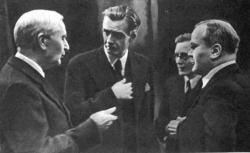
Jozo Krizanovic
 Bosnia and Herzegovina
- Education and professional career
- Entry into national politics
- Chair of the Presidency
- Parliamentary work and later years
Jozo Križanović was a Bosnian politician and mechanical engineer who rose to national prominence during the early years of postwar Bosnia and Herzegovina. A member of the Social Democratic Party of Bosnia and Herzegovina (SDP BiH), he served as the Croat member of the country’s collective Presidency and chaired that body from 2001 to 2002. He later represented his party in the national parliament, where he became a senior parliamentary voice.
Education and professional career
Križanović was born on 28 July 1944 in Vitez, in what is now Bosnia and Herzegovina. He trained as a mechanical engineer and earned a master’s degree in organizational sciences. Before reaching national political office, he worked in public administration and industry.
In 1983–84, he served as president of the municipality of Novi Travnik. He later held leadership positions in the Bratstvo industrial organization, including as its general director during the early 1990s. These administrative and managerial roles formed the foundation of a career that moved between economic institutions and elected politics.
Entry into national politics
Križanović became active in the Social Democratic Party of Bosnia and Herzegovina, a multiethnic party that positioned itself within the country’s postwar political landscape. He entered the national House of Representatives for a short period in 2000. The following year, he was appointed to the Presidency of Bosnia and Herzegovina.
The Presidency is a three-member collective head of state, with one Bosniak, one Croat and one Serb member. In March 2001, the Parliamentary Assembly appointed Križanović as the Croat member, alongside Beriz Belkić as the Bosniak member. He served until the end of 2002, participating in a period when Bosnia and Herzegovina was continuing to rebuild its institutions after the 1992–95 war.
Chair of the Presidency
Under the Presidency’s rotating chairmanship, Križanović took over the role in June 2001. He remained chairman until February 2002, representing the collective body in official duties and meetings. The chairmanship did not make him an individual president with executive power over the other members; instead, he coordinated the work and public representation of a shared, multiethnic institution.
His tenure came amid ongoing international oversight and efforts to strengthen the country’s central institutions. The Presidency was tasked with representing Bosnia and Herzegovina domestically and abroad, while political leaders navigated competing priorities among the country’s constituent peoples and entities. Križanović’s position therefore carried symbolic weight as well as practical responsibilities.
Parliamentary work and later years
After leaving the Presidency, Križanović returned to parliament. He was elected to the House of Representatives of the Parliamentary Assembly of Bosnia and Herzegovina and served in the 2002–06 and 2006–10 convocations. He chaired the SDP BiH parliamentary caucus, giving him a continuing role in party coordination and legislative debate.
Križanović died on 2 December 2009. His career combined engineering and industrial management with political service at municipal and national levels. As a member and rotating chair of the Presidency, he held one of Bosnia and Herzegovina’s highest constitutional offices during a formative period, then continued to represent his party in the country’s legislature.