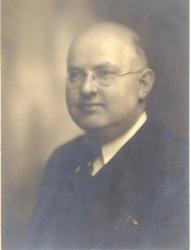
Karl Friedrich Albert Koppen
 Germany
- Childhood and Education
- From Legal Service to Scholarship
- A Career Across Four Universities
- Later Years and Legacy
Karl Christian Friedrich Albert Koeppen was a German jurist and legal historian whose career took him from Prussian legal service into a succession of university posts across the German states. His scholarship focused especially on Roman private law and inheritance, subjects he examined through close analysis of legal doctrine and its historical development.
Childhood and Education
Koeppen was born on December 17, 1822, in Goldberg, then part of Mecklenburg-Schwerin. Biographical accounts report that he attended gymnasiums in Lübeck, Wismar, and Schwerin before moving to Berlin in 1842 to study law at the university. The surviving summaries say little about his family or private childhood, but his education across several northern German towns preceded a career shaped by the rapidly changing academic and legal institutions of the nineteenth century.
From Legal Service to Scholarship
After completing his studies, Koeppen entered the Prussian judicial service in 1847. He soon decided that university teaching and research suited him better: he sought release from government service in 1849 and turned to an academic career. In May 1850, the University of Berlin awarded him a doctorate in both branches of law for a dissertation on the legal nature of an inheritance that had not yet been accepted. Its subject already pointed toward the field that would remain central to his work.
In 1853 he qualified to teach Roman law at the University of Jena, submitting a study of the retroactive effects of accepting an inheritance. He became an associate professor there in 1856. The move from court service to the lecture hall had become complete, and his research into inheritance law developed alongside his teaching.
A Career Across Four Universities
Koeppen was appointed a full professor at the University of Marburg in 1857. His early book Die Erbschaft: Eine civilistische Abhandlung (Inheritance: A Civil-Law Treatise, 1856) treated inheritance as a central problem of civil law. He followed it with a study of contemporary Roman inheritance law, published in installments and completed in 1864. In 1865 he moved to the University of Würzburg, continuing his work on Roman law and private-law doctrine.
In 1872 Koeppen joined the newly established University of Strasbourg as a professor of law. There he produced work on contracts concluded between people who were not physically present together and on the acquisition of fruits by a good-faith possessor—technical questions that illuminate how Roman-law concepts were studied and applied by nineteenth-century jurists. His publications included Der obligatorische Vertrag unter Abwesenden (The Obligatory Contract Between Absentees, 1871) and Der Fruchterwerb der bonae fidei possessor (1872). He also published a concise guide to lectures on the institutions and history of Roman private law in 1879.
His most sustained project was Lehrbuch des heutigen römischen Erbrechts, a textbook on contemporary Roman inheritance law issued in successive parts from 1886 into the 1890s. It gathered the topic that had run through his dissertation, teaching, and earlier books into a longer, systematic treatment.
Later Years and Legacy
Koeppen remained at Strasbourg for more than two decades. Health problems eventually forced him to stop teaching, and he was formally retired in 1895. He died on May 12, 1898, in Lichtenthal, near Baden-Baden.
His career reflects the mobility of nineteenth-century German university life: he taught in Jena, Marburg, Würzburg, and Strasbourg as legal education and political borders shifted around him. His lasting professional contribution was a body of careful scholarship on Roman private law, particularly inheritance, which connected detailed legal interpretation with historical inquiry. The available biographical records emphasize his academic work and do not provide reliable detail about his family life or personal relationships.