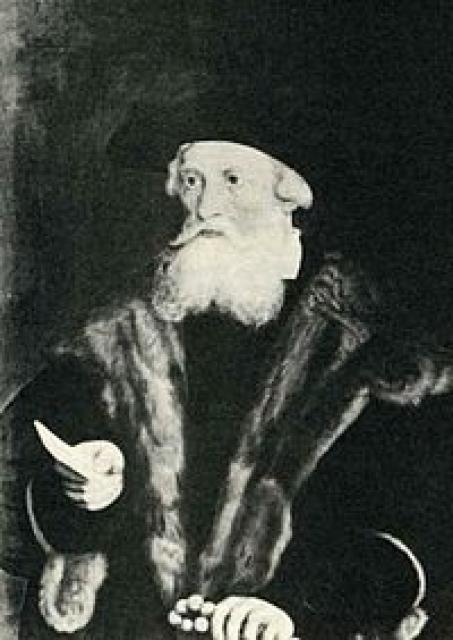
Ludwig V
 Germany
- Early Life and Career
- Marriage and Controversy
- Duke of Bavaria
- Conflict with the Holy Roman Empire
- Later Reign
- Death and Legacy
Early Life and Career
Ludwig V, also known as Ludwig the Brandenburger (May 1315 – September 18, 1361), was the eldest son of Emperor Ludwig IV of the Wittelsbach dynasty. In 1323, at the age of eight, he received the Margraviate of Brandenburg from his father. However, his rule there faced opposition from the local nobility.
Marriage and Controversy
In 1342, Ludwig married Margaret Maultasch, the ruler of the vast County of Tyrol adjacent to Bavaria. However, Margaret was still legally married to her first husband, John Henry of Luxembourg, which caused a scandal across Europe. Despite the support of philosophers William of Ockham and Marsilius of Padua, who claimed it was the "first secular marriage in history," Pope Clement VI, who was engaged in a dispute with Ludwig IV, excommunicated the couple.
Duke of Bavaria
Upon his father's death in 1347, Ludwig V became Duke of Bavaria along with his five brothers. Two years later, the brothers agreed to divide the duchy. Ludwig V, along with his younger brothers Louis VI and Otto V, received Upper Bavaria, comprising the regions of the Lech, Isar, and Amper rivers and the upper Inn Valley.
Conflict with the Holy Roman Empire
As an excommunicated individual, Ludwig V was ineligible to succeed his father as Holy Roman Emperor. The throne instead went to Charles IV of the rival House of Luxembourg. Ludwig V, aided by English King Edward III, attempted to have Günther of Schwarzburg elected as an anti-king, but Günther was defeated and killed shortly after his election. Ludwig V, however, was able to fend off Charles IV's aggression against the Wittelsbach territories, suppressing a revolt in Brandenburg in 1350 and repelling the emperor's invasion of Tyrol.
Later Reign
In 1351, Ludwig V ceded the Margraviate of Brandenburg to his younger brothers in exchange for sole rule over Upper Bavaria. He planned to unite Tyrol with Bavaria permanently and created a unified administration for both principalities. The publication of Charles IV's Golden Bull in 1356, which limited the number of German princes eligible to elect the emperor to seven (excluding Bavaria), further strained Ludwig V's relationship with the emperor. In 1359, with the support of the Habsburgs, he successfully lifted the excommunication against himself and his wife.
Death and Legacy
Ludwig V died in September 1361 while traveling from Tyrol to Munich. He was succeeded by his son, Meinhard III. Ludwig V's rule was marked by conflict with the Holy Roman Empire but also by a desire to unify his territories and strengthen the Wittelsbach dynasty. His marriage to Margaret Maultasch remains a notable historical event due to its controversial nature.


