Moris Gamelen
 France
Biography of Maurice Gamelin
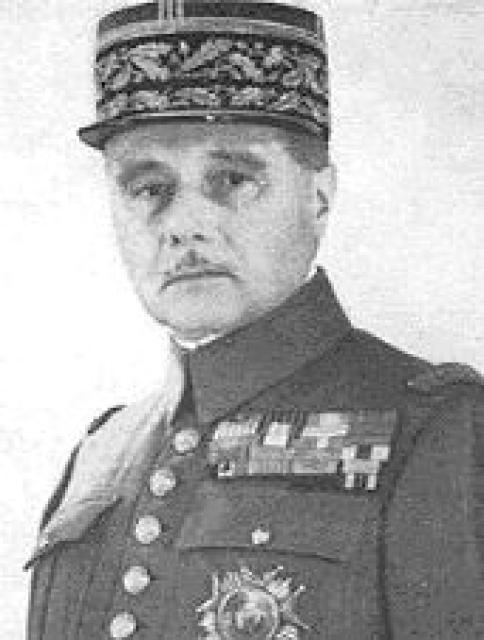
Maurice Gustave Gamelin (September 20, 1872, Paris - April 18, 1958, same place) was a French general. He graduated from the Saint-Cyr Military Academy in 1893 and the Staff College in 1899. He received his education at the Saint-Cyr Military Academy in 1891, graduating first in his class, and at the War Academy in 1901. He began his service in 1893 as a sub-lieutenant in the 3rd Algerian Rifle Regiment. From 1904, he served in the 15th Chasseur Battalion. Starting in 1906, he became an aide-de-camp to Georges Joffre, who later provided him with constant support. In 1911, he became the head of Joffre's office and was later appointed commander of a chasseur battalion. Gamelin participated in World War I, initially serving as Joffre's aide-de-camp, then commanding a chasseur battalion, and leading Joffre's staff office. From 1916 to 1918, he commanded the 16th Division. He gained fame as a war hero and established extensive connections in political and business circles. From 1919 to 1925, he served as the head of the French military mission in Brazil. From 1925 to 1927, he commanded the troops in the Levant. He became renowned for his actions during the Syrian Campaign, becoming one of France's most popular military figures. On September 16, 1926, he was appointed a Grand Officer of the Legion of Honor, and on July 8, 1932, he was awarded the Grand Cross. From 1929 to 1930, he commanded the XX Corps with headquarters in Nancy. In 1930, he was appointed Quartermaster General and First Deputy Chief of Staff. On February 9, 1931, he succeeded General Maxime Weygand as Chief of the General Staff and simultaneously became a member of the Supreme War Council. He sought to develop aviation and armored forces, but in 1935, he was removed from the position of Chief of the General Staff due to political intrigues. On July 8, 1932, he was awarded the Grand Cross of the Legion of Honor. From January 21, 1935, to September 1939, he served as the Inspector General of the Armed Forces, and from January 21, 1935, to May 19, 1940, he was the Vice-President of the Military Council. He continued to advocate for the modernization of the French army. On January 21, 1938, he was appointed Chief of Staff of National Defense. In 1939, during negotiations with the Polish delegation, Gamelin recommended that the Poles yield to Germany's demands and not enter into any agreement with the Soviet Union. In 1938, he was awarded the Grand Cross of the Victoria Order, and in 1939, the Grand Cross of the Order of the Bath. On September 3, 1939, France declared war on Germany, and Gamelin took command of the operational headquarters of the army (with headquarters at the Château de Vincennes), exerting enormous influence over General Maurice Georges, the Commander-in-Chief. Under his command were three army groups, totaling 103 divisions, as well as 22 Belgian and 10 Dutch divisions. However, Gamelin refused to strike against the weakened German forces on the Western Front and adopted a defensive position. He dispersed France's tank units in small groups along the entire front. On May 10, 1940, German forces attacked the French armies, and the French defense was breached. By May 13, German troops had reached operational depth (and did not attack the well-fortified Maginot Line, as the French command led by Gamelin had hoped). Gamelin attempted to rectify the situation by regrouping his forces and preparing a counterattack, but due to his own mistakes, this plan failed completely. On May 17, Gamelin ordered the British Expeditionary Force and French troops to immediately withdraw to the south towards the Somme. On the same day, he was removed from the position of Commander-in-Chief (replaced by General Weygand), and his order was rescinded (resulting in the Dunkirk catastrophe). In September 1940, he was arrested on charges of treason. He was imprisoned and held in custody. In 1942, a trial was held in Riom on the territory of Vichy-controlled France, where Gamelin was found guilty of the collapse of the army and France's defeat in the war. In April 1943, he was deported to Germany and imprisoned in a concentration camp. In 1945, he was liberated by the Allies. Upon his return to France, he withdrew from political life. He authored memoirs.