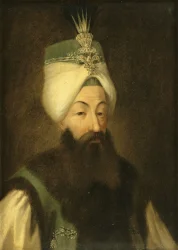
Murad II
Murad II ruled the Ottoman Empire through two separate reigns, strengthening a state beset by dynastic rivals and pressure from Christian powers in the Balkans. His career included a rare episode in medieval kingship: he voluntarily placed his young son Mehmed on the throne, withdrew from rule, then returned when a European crusade threatened the empire. His victories at Varna and Kosovo secured the foundations on which Mehmed II would later build.
An Unsteady Accession
Murad became sultan in 1421 after the death of his father, Mehmed I. Still a young ruler, he had to contend with challenges from rival claimants and with Byzantine efforts to influence Ottoman succession disputes. He fought to restore central authority and then turned to the empire’s contested frontiers. In 1422, he besieged Constantinople, though the Byzantine capital remained beyond Ottoman control during his reign.
Murad expanded Ottoman power in the Balkans and Anatolia through a mix of warfare, diplomacy, and negotiated submission. In 1430, his forces captured Thessalonica from Venice after a prolonged siege, bringing a major port and commercial center under Ottoman rule. The campaign reflected the sultan’s ability to exploit competing interests among regional powers while consolidating territory for the dynasty.
Abdication, Varna, and Return
After concluding peace agreements in 1444, Murad abdicated in favor of his twelve-year-old son Mehmed, who would become known as Mehmed the Conqueror. Murad withdrew from the throne, but the arrangement did not last. A new crusade against the Ottomans gathered under the Hungarian king Władysław III and the general John Hunyadi. The young sultan and his advisers called Murad back to lead the army.
At the Battle of Varna in November 1444, Murad’s forces defeated the crusading army, and King Władysław was killed. Murad briefly returned to retirement, but court tensions and unrest brought him back to power in 1446. Mehmed was sent to govern in Manisa, while his father resumed direct rule. In 1448, Murad again defeated Hunyadi’s army at the Second Battle of Kosovo, reinforcing Ottoman dominance in the Balkans and ending a major threat of a renewed crusade.
Consolidation and Legacy
Murad’s final years were marked by a stronger, more stable empire than the one he had inherited. He supported architecture and court culture, including the construction of religious and civic foundations in Edirne and Bursa. His reign also fostered the literary and artistic life of the Ottoman court, even as military campaigns remained central to the sultanate’s security.
Murad died in 1451, and Mehmed returned to the throne. The father’s decision to abdicate and the son’s eventual succession became an unusual prelude to the conquest of Constantinople in 1453. Murad himself is remembered as a capable consolidator: a ruler who overcame rebellion, expanded Ottoman reach, and left his heir an empire poised for a new era of expansion.