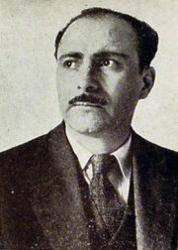
Nikolay Avvakumov
Early Life and Education
Nikolai Mikhailovich Avvakumov was born on August 24 (September 6, N.S.), 1908, in the town of Asbestosovye Rudniki (now Asbest), Perm Governorate, Russia. His mother, F.I. Avvakumova, was the town's first teacher. Avvakumov completed his schooling and vocational training in Asbestos.
From 1925 to 1928, Avvakumov studied at the Perm Art and Pedagogical College, completing the four-year program in just three years under the guidance of renowned artist I.Y. Khazov.
Artistic Career
Documenting Soviet IndustrializationIn March 1929, Avvakumov became a member of the Ural branch of the Association of Artists of Revolutionary Russia (AKhR). He played a vital role in documenting the first Soviet five-year plans, creating a visual chronicle of the era's industrialization. In 1930, he worked at the Magnitogorsk Iron and Steel Works, known as Magnitka, where he produced a significant body of graphic art that depicted the life and labor of the workers.
Wartime and Military Service
Following the outbreak of World War II, Avvakumov enlisted in the Red Army in December 1941. From 1942 to 1944, he served as an artist-correspondent for the newspaper "Frontovik" on the 3rd Shock Army. In 1942, he joined the Communist Party of the Soviet Union.
Avvakumov was awarded the "For Battle Merit" medal in 1943 and the Order of the Red Star in 1944. As part of the Studio of War Artists named after M.B. Grekov, he traveled to various fronts and cities during the war, capturing the experiences of soldiers and the devastation caused by the conflict.
Legacy
After the war, Avvakumov continued to work as an artist until his untimely death in Moscow on December 8, 1945. He was buried in the Donskoy Cemetery. In 1958, the Studio of War Artists unveiled a sculptural portrait of Avvakumov on his grave, created by his friend, renowned sculptor Yevgeny Vuchetich.
Nikolai Mikhailovich Avvakumov's legacy lives on through his powerful graphic art, which provides a vivid and moving record of the Soviet era and the sacrifices made during World War II.