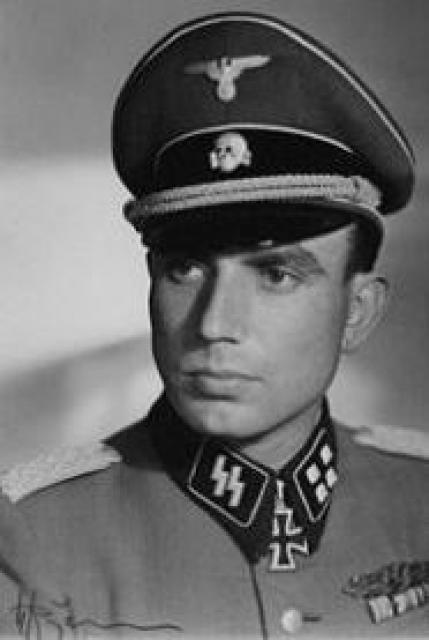
Otto Weidinger
 Germany
- Early Life and SS Career
- World War II: Early Campaigns
- Eastern Front
- Return to Combat
- Awards and Promotions
- France and Hungary
- Post-War
Early Life and SS Career
Otto Weidinger was born in Germany and joined the SS-Verfügungstruppe in 1934. He graduated from officers' college in 1936 as an Untersturmführer (lieutenant).
World War II: Early Campaigns
Weidinger fought in the Polish Campaign (1939) and the French Campaign (1940) as deputy commander of a reconnaissance battalion. He earned Iron Crosses of both degrees. In July 1940, he became commander of the reconnaissance battalion with the rank of Hauptsturmführer (captain). He participated in the invasion of Yugoslavia in 1941.
Eastern Front
From June 1941, Weidinger fought on the Eastern Front. He was severely wounded during the battle of Moscow. After recovering, he taught at a military school from November 1941.
Return to Combat
In June 1943, Weidinger rejoined the Eastern Front as commander of an infantry battalion in the SS Division "Das Reich." He fought in the Battle of Kursk and was again severely wounded. In late 1943 and early 1944, he fought in Ukraine.
Awards and Promotions
In April 1944, Weidinger was awarded the Knight's Cross and promoted to Obersturmbannführer (lieutenant colonel). The "Das Reich" Division was then transferred to France.
France and Hungary
In June 1944, Weidinger became commander of a grenadier regiment in the "Das Reich" Division. He fought in Normandy against Allied forces. He was awarded Oak Leaves to the Knight's Cross in December 1944. In 1945, he fought in Hungary and was awarded the Swords (No. 150) to the Knight's Cross with Oak Leaves on May 6, 1945.
Post-War
After the German surrender, Weidinger surrendered to American forces in Austria. He was extradited to France, where he was tried for his alleged involvement in the destruction of civilians in Oradour and Tulle. He was acquitted and released from prison in 1951.


