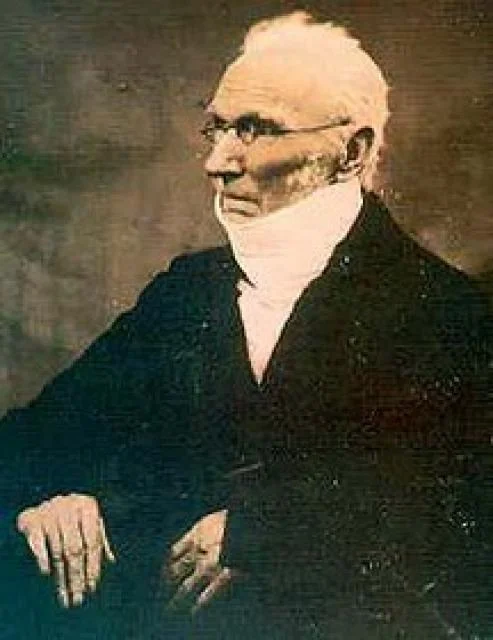
Patrick Bronte
 Great Britain
- From County Down to Cambridge
- A clergyman, writer, and father
- Life in Haworth
- A legacy beyond the parsonage
Born Patrick Brunty in County Down, Ireland, on 17 March 1777, Patrick Brontë became an Anglican clergyman, teacher, and author whose name is inseparable from one of literature’s most celebrated families. He was the father of Charlotte, Emily, and Anne Brontë, but he also built a life and literary career of his own. For more than four decades, he served the parish of Haworth in Yorkshire, where the family’s home and the surrounding moors became part of the Brontë story.
From County Down to Cambridge
Brontë grew up in a large farming family and worked as an apprentice before a local clergyman recognized his ability and helped further his education. He taught at a school as a teenager, then studied under the Rev. Thomas Tighe, who secured him a scholarship to St John’s College, Cambridge. Arriving in 1802 as a sizar, a student whose costs were subsidized, he studied divinity and history and won academic prizes.
During his university years, he changed his surname from Brunty to Bronte, later adopting the familiar spelling Brontë. The change is often linked to his admiration for Admiral Horatio Nelson, who held the Sicilian title Duke of Bronté. After graduating in 1806, he was ordained in the Church of England and began serving as a curate.
A clergyman, writer, and father
Brontë held appointments in Essex and Shropshire before settling in Yorkshire. In 1812 he married Maria Branwell, and the couple had six children: Maria, Elizabeth, Charlotte, Branwell, Emily, and Anne. In 1820, he accepted the post of perpetual curate at Haworth and moved his family into the parsonage beside the church.
Maria died in 1821, leaving Brontë to raise the children with help from her sister, Elizabeth Branwell. He was a strict and frugal parent, but the family home was rich in books, newspapers, and periodicals. He encouraged his children’s education and did not suppress their early appetite for writing. Charlotte, Emily, and Anne would go on to publish novels that transformed English literature, while their brother Branwell also pursued creative work.
Brontë’s own writing included verse collections such as Winter-Evening Thoughts (1810), Cottage Poems (1811), and The Rural Minstrel (1813), as well as the narrative The Maid of Killarney (1818). He also published sermons, pamphlets, and letters in local newspapers. His writing and public activity reflected religious conviction and engagement with questions of education, poverty, slavery, and capital punishment.
Life in Haworth
Haworth’s poor sanitation and polluted water contributed to the harsh conditions of parish life. Brontë campaigned for a clean water supply and worked to improve the village’s circumstances. He remained the parish incumbent until 1860, stepping down shortly before his death.
His family endured repeated losses. His wife died while their children were young; the two eldest daughters, Maria and Elizabeth, died after becoming ill at school. Later, Brontë outlived his son Branwell and daughters Emily, Anne, and Charlotte. Charlotte’s marriage to his curate, Arthur Bell Nicholls, initially met with his resistance, but Nicholls remained with Brontë in Haworth after her death.
A legacy beyond the parsonage
Brontë died on 7 June 1861, aged 84, and was buried at Haworth church. In his later years, he collaborated with Elizabeth Gaskell on The Life of Charlotte Brontë, a biography that offered a sharply unflattering picture of him. Later accounts have questioned how fairly that portrait represented a father who supported his daughters’ education and writing.
His enduring significance lies both in his own work and in the literary environment he helped create. At the Haworth parsonage, his children read widely, followed public affairs, and began inventing stories from an early age. Patrick Brontë’s life thus occupies two histories at once: that of an Irish-born clergyman who made a home and career in Yorkshire, and that of the family whose novels continue to captivate readers around the world.


