Philippe III
 Belgium
- Biography of Philip III the Good
- Marriages and Children
- Rise to Power
- Conflict and Expansion
- Legacy and Cultural Patronage
Biography of Philip III the Good
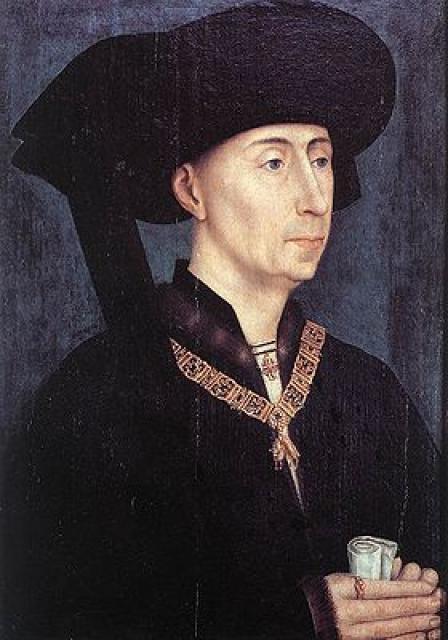
Philip III the Good was born in Dijon, France, on January 28, 1405. He was the eldest son of John the Fearless and Margaret of Bavaria. In 1419, after the death of his father, Philip became the Duke of Burgundy.
Marriages and Children
In 1409, Philip married Michelle of France, the daughter of Charles VI of France and Isabella of Bavaria. After Michelle's death, he married Bonne d'Artois in 1424. Bonne was the daughter of Philip of Artois and the widow of Philip II, Count of Nevers. In his third marriage, which took place in 1430, Philip married Isabella of Portugal, the daughter of John I of Portugal and Philippa of Lancaster. Philip and Isabella had three sons, including Charles, who would later become the Duke of Burgundy. Philip also had around 17 illegitimate children.
Rise to Power
Philip III the Good became the Duke of Burgundy after the assassination of his father in 1419. He accused the Dauphin of France, Charles, of his father's murder. In 1420, Philip formed an alliance with King Henry V of England. This alliance was strengthened in 1423 with the marriage of Philip's sister Anne to John, Duke of Bedford, the regent of England during the minority of King Henry VI. Philip acted as the regent of France for Henry V, who inherited the French throne after Charles VI's death.
Conflict and Expansion
Philip's alliance with the English ended in 1435 when he recognized Charles VII as the King of France under the Treaty of Arras. However, this treaty was violated in 1439, and Philip supported a rebellion of French nobles known as the Praguerie. During the Hundred Years' War, Philip preferred not to take sides and instead focused on expanding his own territory. He acquired Namur in 1429 and several Dutch territories, including Friesland and Zeeland, in 1432. After the death of his cousin Philip of Saint-Pol in 1430, he inherited the Duchy of Brabant and the Margraviate of Antwerp. In 1443, he purchased the Duchy of Luxembourg from his aunt Elizabeth of Gorlitz. With these acquisitions, Philip referred to himself as the "Great Duke of the West."
Legacy and Cultural Patronage
Despite losing some territories to Louis XI in 1463, Philip III the Good left a lasting impact. He supported the concept of chivalry at his court and created the Order of the Golden Fleece in 1430. His duchy had no fixed capital, and the court moved between Brussels, Bruges, and Lille, where grand knightly tournaments were held. Philip had a great appreciation for art and amassed a large collection of tapestries and other works. Under his rule, the Burgundian Chapel became a musical center in Europe, with renowned composers and singers such as Gilles Binchois, Robert Morton, and later Guillaume Dufay performing at his court.
In 1428, Philip sent Jan van Eyck to Portugal to paint the portrait of his bride-to-be, Infanta Isabella. Additionally, Philip established his own shipyard in Bruges with the help of skilled Portuguese shipbuilders.
Philip III the Good passed away in Bruges in 1467, leaving behind a legacy of political alliances, territorial expansion, and cultural patronage.