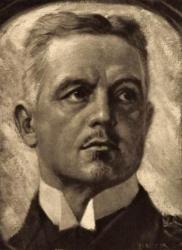
Quintus Asconius Pedianus
 Italy
Italy- Asconius Pedianus: Roman Scholar and Grammarian
- Literary Contributions
- Commentary on the Speech against Piso
- Discovery and Preservation
- Attribution and Authenticity
Asconius Pedianus: Roman Scholar and Grammarian
Asconius Pedianus was a notable Roman writer and philologist born in Patavium (modern-day Padua). His authorship spanned the reigns of emperors Claudius and Nero.
Literary Contributions
During his life, Pedianus authored several works, including a biography of historian Sallust and a treatise defending Virgil from critics. Unfortunately, these writings have not survived.
However, his most significant contribution to Latin literature is his commentaries on the speeches of Marcus Tullius Cicero, composed between 54 and 57 CE. Of these, only five have come down to us:
Commentary on the Speech against Piso
Commentary on the Speech for CorneliusCommentary on the Speech against Scaurus
Commentary on the Speech for Milo
Commentary on the Speech in Toga Candida
Historical Importance
Pedianus' commentaries are highly valued by historians and scholars alike. They provide valuable insights into the political and legal landscape of Rome during Cicero's time. Moreover, they help reconstruct two lost speeches of Cicero, providing access to historical events that might have otherwise been obscured.
Pedianus drew upon reliable sources that are no longer extant, such as Senate proceedings. His commentaries are thus a window into the inner workings of Roman society.
Discovery and Preservation
The known commentaries of Pedianus were discovered in 1416 in a single manuscript from the Gallican Library. However, this manuscript was subsequently lost, leaving only fragments of Pedianus' work. Despite its damaged state, the manuscript contained a wealth of factual and grammatical explanations, revealing Pedianus' mastery of Latin prose.
Attribution and Authenticity
Pedianus was erroneously attributed to the authorship of additional commentaries found in the same manuscript. However, modern scholarship has established that these commentaries were written by a later author.