Radola Gayda
 Czech
CzechBiography of Radola Gajda
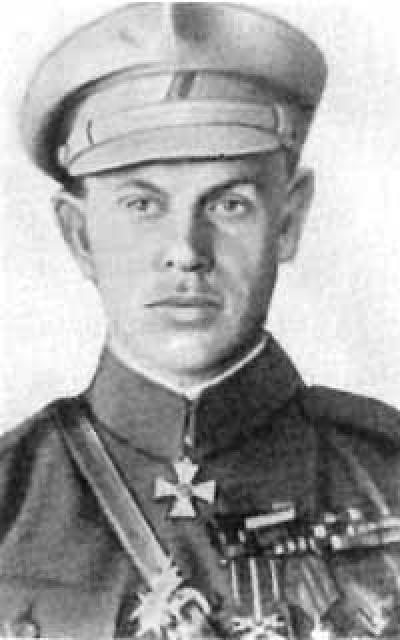
Radola Gajda was a Czechoslovak counterrevolutionary military figure who played a prominent role in the early 20th century. Born as Rudolf Geidl in 1892, Gajda was a talented adventurer of Czech nationality. He first gained military experience as a participant in the First Balkan War against Turkey in 1912, where he fought in the Battle of Scutari.
Gajda initially served as a military medic in the Austro-Hungarian army, but later assumed the rank of an officer (ensign). On October 30, 1914, he defected to the Montenegrin forces, posing as a captain while being held as a prisoner of war. He joined the ranks of the Montenegrin army and successfully led them in their retreat to the sea through Albania, maintaining their fighting spirit.
Later, Gajda traveled to Petrograd (now Saint Petersburg) on a medical train, disguising himself as a Russian doctor. He was then accepted into a Serbian division under Russian command and returned to the front lines. In September 1916, he was transferred as a junior officer to the 2nd Czechoslovak Regiment, and quickly rose through the ranks to become a company commander and later a battalion commander.
While in Ukraine, Gajda joined the Czechoslovak legions that were being formed there. In the spring of 1917, after the battle of Zborov where Gajda displayed personal courage and heroism, he was awarded the Officer's George Cross 4th class and given command of the 7th regiment of the Czechoslovak Corps. He attended the Congress of Delegates of all corps units in Chelyabinsk on May 20, 1918, where he was elected to the Military Council for coordinating the actions of scattered corps groups and establishing communication with local anti-Bolshevik groups.
On the night of May 25, 1918, Gajda, as a captain, led a successful uprising in Novonikolaevsk, becoming the first to do so in the Czechoslovak Corps. He surrounded and arrested the local Council of Workers, Peasants, and Soldiers. Gajda achieved significant successes and a remarkable career, becoming one of the prominent military leaders. He commanded a part of the Siberian group of the Czechoslovak Corps, leading 4,500 soldiers. His troops participated in the Mariampol battles from May 24 to 28, 1918, near Omsk, where they inflicted a serious defeat on the Bolsheviks, leading to the fall of Omsk, which they took on June 7, 1918. On June 10, 1918, Gajda's forces joined the Chelyabinsk group of the Czechoslovak Corps, and on July 11, 1918, they met with Diterikhs' Transbaikal group under Irkutsk. Gajda played a significant role in capturing the Trans-Siberian Railway in June and July 1918 and contributed to the establishment of the authority of the West Siberian Commissariat in Omsk.
In July and August 1918, Gajda outmaneuvered superior Red forces during his retreat near Irkutsk, luring them into an ambush and defeating them. He occupied the strategically important Krasnoyarsk tunnels, preserving them intact and preventing their destruction. Gajda then executed a swift maneuver across Lake Baikal, delivering a devastating blow to the Bolsheviks in their rear. On August 7, 1918, together with Pepelyaev's forces, he defeated a large Red detachment on the Pribylovsk Front in an event that became known as the "Disaster at Posolskaya." For his victories in Eastern Siberia, Gajda was promoted to the rank of colonel, and later to major general.
Gajda became close to the Socialist-Revolutionaries (Esers) and joined the supporters of the Siberian Regional Duma. In August 1918, he ordered Semyonov and Khorvat to come to him, threatening them with a military court for non-compliance. Khorvat obeyed the order, but Semyonov did not, insisting on Gajda's removal from the position of commander of the Siberian Army. Vologodsky promised to replace him with A. Pepelyaev. A. Pepelyaev became the intermediary in resolving the conflict between Gajda and Semyonov. Gajda invited Semyonov and Pepelyaev to a dinner, where they resolved the misunderstanding between them.
In August and September 1918, Gajda unsuccessfully sought to be appointed the Supreme Commander of the anti-Bolshevik forces in Siberia. Some ministers supported him, hoping that his appointment would gain the support of the United States instead of Ivanov-Rinov. In September 1918, he became a major general and the commander of the 2nd Czechoslovak Division. Gajda played a positive role in the liquidation of the Siberian Directorate, accepting Gloss, who was arrested by A. Pepelyaev for interfering in Siberian affairs. He was nominated for the position of Supreme Commander of the Siberian Army on September 21, 1918, in Vladivostok by Gins and Vologodsky after convincing them with the help of Lieutenant Kalashnikov. From October 1918 to January 1919, he led the Ekaterinburg group of the Siberian Army with 22,000 soldiers.
Gajda was known as a Russophile among the Czechoslovak Corps forces. It was largely due to his efforts that Russian forces under the control of Czechs and Slovaks switched sides and joined Kolchak in November 1918. He supported dictatorship in the fight against the Bolsheviks. Gajda became the commander of Kolchak's Siberian Army, holding the rank of lieutenant general. Under his command, Omsk and other cities were captured from the Bolsheviks in March 1919. He established connections with the Northern Region forces and captured Sarapul and Izhevsk in April.
However, Gajda clashed with Kolchak's Chief of Staff, Lebedev, expressing general dissatisfaction with him in Siberia due to the failure of the spring offensive in 1919. During the Red Army's advance in May and June 1919, Gajda continued his own offensive in the center of the front, capturing Glazov, but soon had to start a retreat, blaming Lebedev and Khanzhin. The Minister of War of Czechoslovakia, Stefanek (Stefanek), demanded Gajda's dismissal and departure from Siberia as an adventurer as early as the end of 1918. However, under pressure from Kolchak's entourage, he decided against it, predicting the downfall of the White movement in eastern Russia due to Gajda. After being relieved of his command, Gajda went on a "foreign leave" to the Far East in July 1919, receiving 70,000 francs in gold from Kolchak. According to one version, he attempted to smuggle out colossal valuables on this journey. Arriving in Vladivostok in August 1919, he became one of the leaders of the anti-Kolchak movement organized by the Socialist-Revolutionaries, making contact with Medvedev, Moravsky, Yakushev, Krakovecky, Boldyrev, and Khorvat. He maintained contacts with leaders of the Socialist-Revolutionaries such as Zhernakov, Zakharov, Yudin, and others through his ordinary, Molotkovsky. However, these contacts were infrequent. On November 17, 1919, Gajda made an unsuccessful attempt to seize power in Vladivostok. He was captured by General Rozanov's troops but was released under pressure from the "allies" and put under the command of the Czechoslovak Corps. During negotiations for his release, Gajda was forced to leave some of his comrades who had been captured by the White Guards in Rozanov's hands. In December 1919, he left for Czechoslovakia. In 1924, he published his memoirs there. Together with other prominent figures, he organized the Prague Legiobank with the gold he brought from Russia. He plotted a fascist coup, but was exposed, arrested by SMERSH in June 1945, and sentenced for his actions in 1918-1919 on the territory of the USSR and for supporting Germany's war against the USSR. He was hanged according to the court's ruling.
Conversation with Kolchak:
...Gajda approached me at that time regarding his appointment as the Supreme Commander of the Russian and Czech armed forces operating in Siberia to obtain the government's sanction for his authority. "How would you react to this?" he asked me. I said, "For me, the question of subordination to one or another armed force is always determined practically. I do not know the composition of the Russian forces, and if you are all more organized and have greater strategic value, then it would be quite natural for the command to belong to you. If the situation changes in favor of the Russians, then there should be Russian command—otherwise, the question cannot be resolved. Tell me, what is the Directorship and what does it represent?" He replied, "It is an organization that, undoubtedly, is lifeless. I do not believe that this Directorship can unite all Russian units and forces operating here in Siberia and in other territories. I personally think that it cannot, and I have information that the Omsk Government is generally negative about this idea. But Vologodsky himself has become part of the Directorship and has thus put himself under its authority." I said, "In these circumstances, what form of authority do you consider to be the best?" He said, "I believe that, in this period and under these conditions, there can only be military dictatorship." I replied, "First and foremost, military dictatorship presupposes an army upon which the dictator relies, and therefore, it can only be the authority of a person who has the army at his disposal. But such a person does not exist because there is not even a unified command. For dictatorship, a prominent military figure is needed, whom the army would trust and recognize, and only under such conditions is it possible. Dictatorship is a military management, and it is ultimately based entirely on armed forces. And since there is no such armed force yet, how will you create this dictatorship?" He answered, "Of course, this is a question for the future because everything is still in the process of creation and development. But personally, I believe that this is the only way possible in these circumstances." We parted ways after this conversation.
Source:
- A.V. Kolchak. Minutes of the meeting of the extraordinary investigation commission on the case of Kolchak. (Stenographic report). Meeting of the Extraordinary Investigation Commission on January 23, 1920. Quoted from the book: "Near Kolchak: Documents and Materials." Compiled by A.V. Kvakin. Moscow, 2007. Pages 425-426.
D.V. Filatov on Gajda:
...There is a certain Gajda, the same one who recently stood trial in Prague for spying in favor of the Bolsheviks. Gajda began his military career as a medic in the Austrian army, but showed exceptional military abilities and was promoted to the rank of officer during the war. Along with other Czechs, he became a prisoner of war and continued his service in one of the Czech units on our front. In Siberia, he quickly reached the rank of general and was one of the few Czech leaders who advocated continuing the fight alongside the Russians against the Bolsheviks. His ambition and thirst for power were limitless. He had great political intuition and the ability to connect with public figures. With his bold plans and energy, he completely conquered the naive Admiral Kolchak, who considered Gajda his loyal and devoted friend.
However, the Czechs themselves knew Gajda better, and when the Czech Minister Stefanek, who had been in Omsk, was asked for permission for Gajda to transfer to Russian service, he replied, "Take him, but I warn you that you are mistaken in him. He will either be your field marshal or your traitor." D.V. Filatov. The Catastrophe of the White Movement in Siberia: 1818-1922. Impressions of an Eyewitness. Paris, 1985. 144 p. Quoted from the book: "Near Kolchak: Documents and Materials." Compiled by A.V. Kvakin. Moscow, 2007. Pages 221-222.